3 nights in W Melbourne, 1 night in Novotel Melbourne Airport
Melbourne is the capital and largest city of Victoria, and the second-most populous city in Australia. The area has been inhabited by Aboriginal peoples for over 40,000 years. Founded in 1835, it grew rapidly during the gold rush and briefly served as Australia’s capital after federation. Today, Melbourne is known for its mix of historic and modern architecture, vibrant arts and music scene, and major sporting events like the Australian Open Tennis tournament.
Most of the attractions in Melbourne city were within walking distance of our hotel, so we explored most of them over three days on foot.
Victorian Heritage Register (VHR) – There are many places and objects considered culturally significant to the state of Victoria and is listed in Victorian Heritage Register (VHR). These heritage-listed sites are legally protected under the Heritage Act 2017 and are overseen by the planning minister.
- Day 1
- Flinders Street Station
- St Paul Cathedral (Victorian Heritage Register)
- Federation Square (Victorian Heritage Register)
- Melbourne Skydeck
- Shrine of Remembrance (Victorian Heritage Register)
- Phillip Island
- Day 2
- Melbourne Cricket Ground tour (Victorian Heritage Register)
- Yarra Park
- Fitzroy garden
- Street art on Hosier Lane
- Block Arcade (Victorian Heritage Register)
- Royal Arcade (Victorian Heritage Register)
- Queen Victoria Market (Victorian Heritage Register)
- State Library Victoria (Victorian Heritage Register)
- St Francis Church (Victorian Heritage Register)
- Day 3
- Carlton Gardens (UNESCO World Heritage Site)
- Old Melbourne Gaol (Victorian Heritage Register)
- Yarra River and Yarra River Walk
- Alexandra Gardens
- Queen Victoria Garden
- Ride the city Circle Tram
- Interesting Buildings Along the Way
————— Day 1 —————
Flinders Street Station – We began our first day in Melbourne with a short 10-minute walk from our hotel to the Flinders Street Station, located at the corner of Flinders and Swanston Streets. Completed in 1910, this historic station is Australia’s oldest and busiest, known for its distinctive yellow façade, copper dome, and famous entrance clocks. Designed in the French Renaissance style, it serves as a major transport hub for Melbourne’s rail network and handles over 110,000 commuters daily. It also features one of the world’s longest railway platforms, measuring 708 meters.
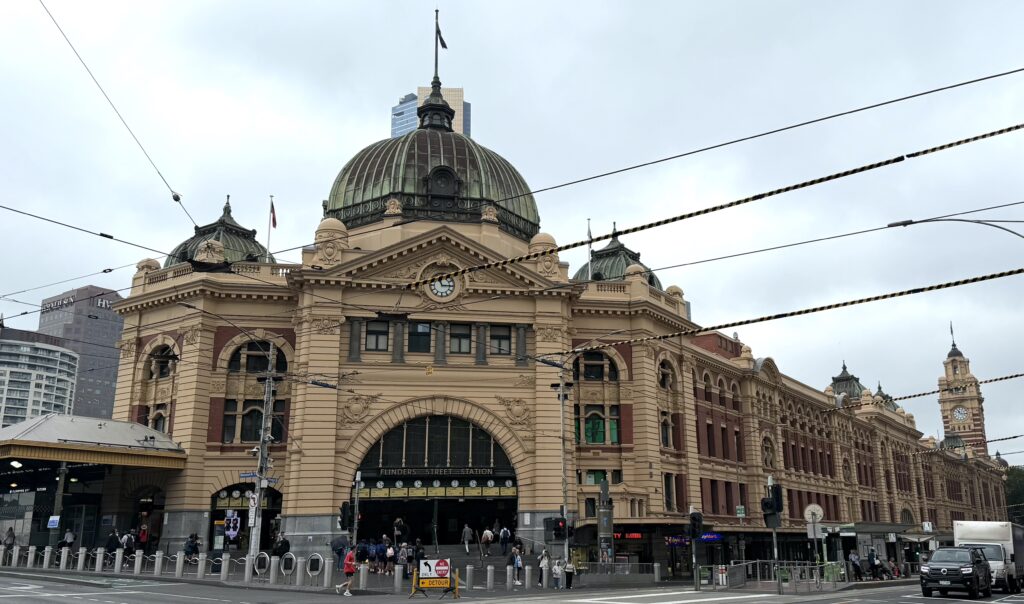
We spent a few minutes here, admiring the exterior, taking photos, and briefly stepping inside to have a quick look around.
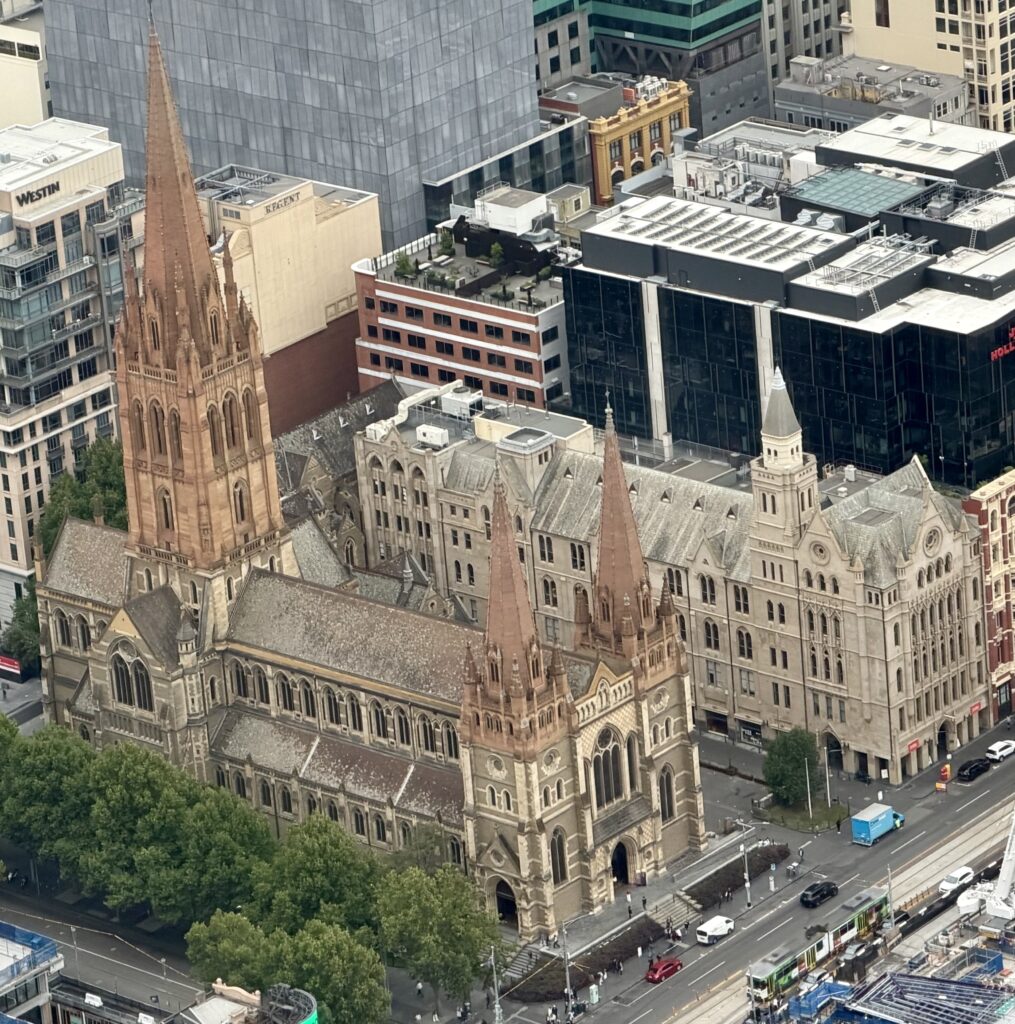
St Paul Cathedral – is located directly opposite Flinders Street Station and is the largest Anglican cathedral in Australia and the seat of the Archbishop of Melbourne. Designed by William Butterfield in the Gothic Revival style, it was completed in 1891, with its spires added later (1926–1932).
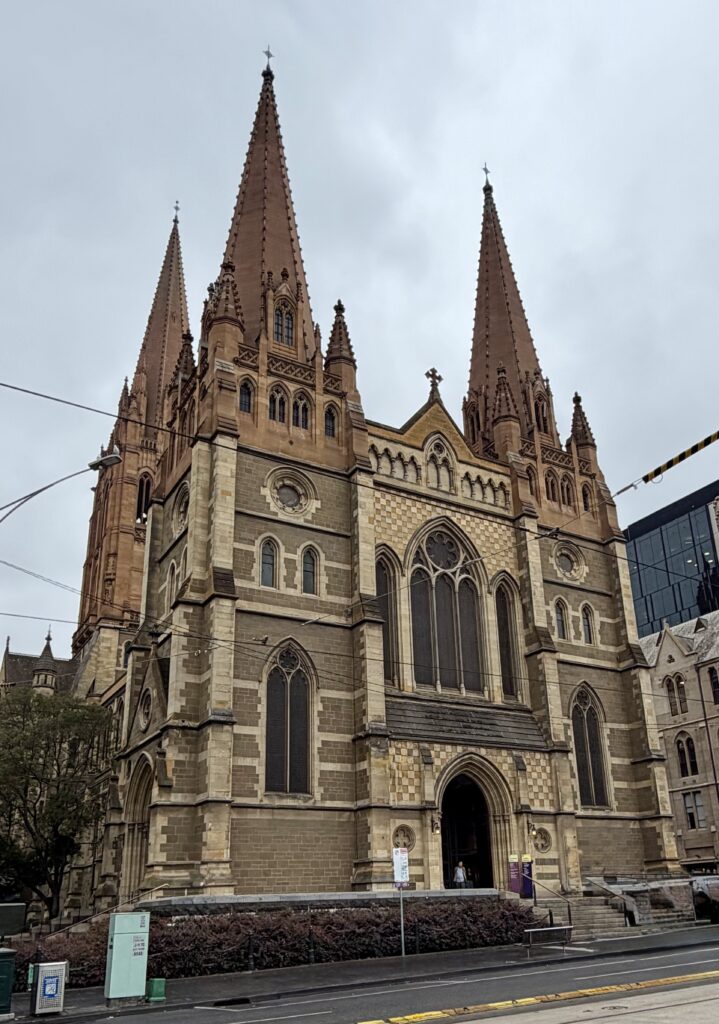
The interior of St Paul’s Cathedral is richly decorated with bold colors and strong contrasts, typical of William Butterfield’s style. Built using Waurn Ponds limestone and dark bluestone, it showcases High Victorian Gothic polychromy, especially in the floor, dado, high altar, and reredos (the ornamental screen covering the wall at the back of an altar). The cathedral floor is paved with decorative encaustic tiles from the English firm Maw & Co., while the walls include patterned glazed tiles.
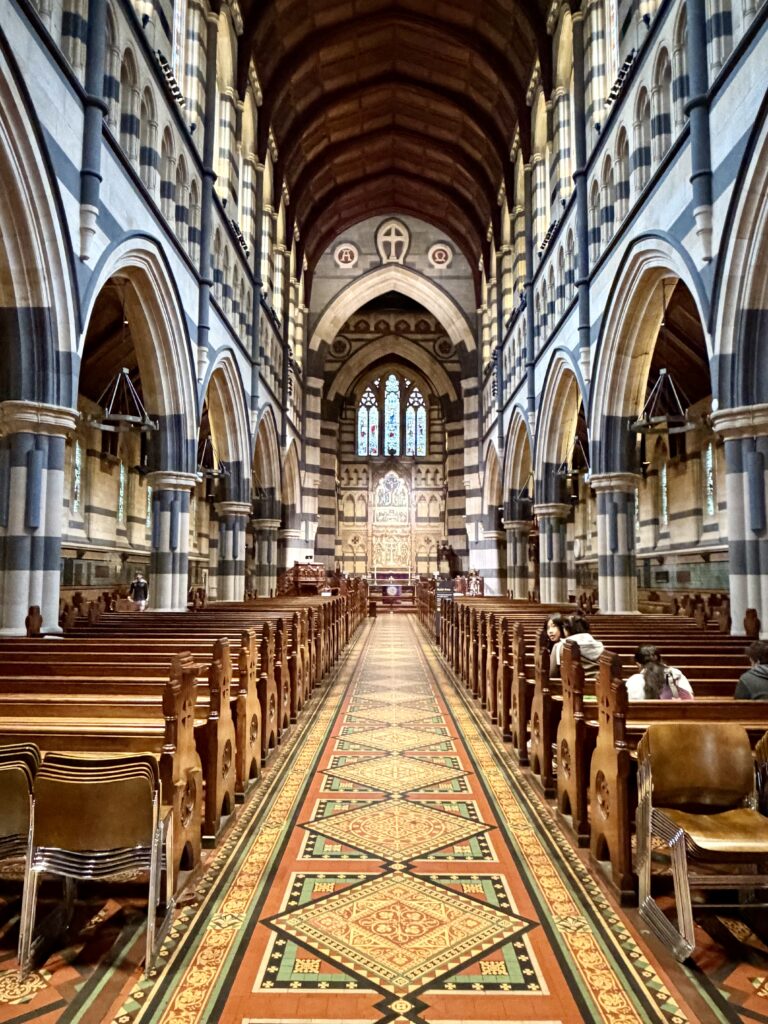
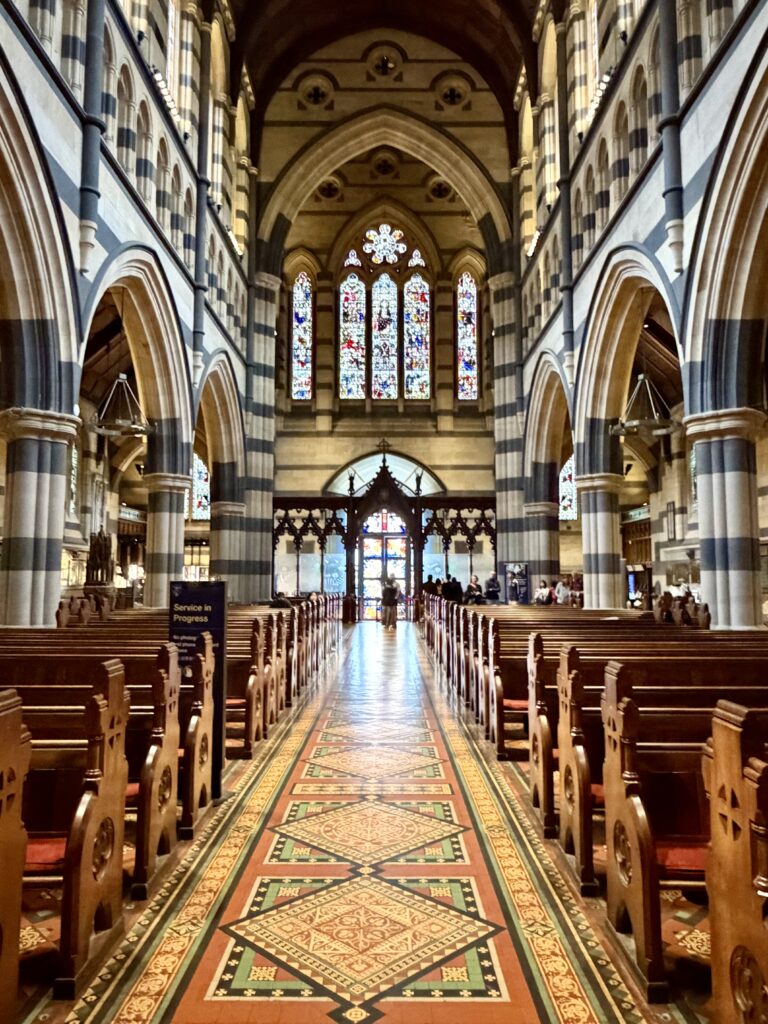
St Paul’s Cathedral features beautiful Neo-Gothic stained glass windows installed between 1867 and 1957, depicting scenes from the Bible. Notable designs, such as the Seven Stories of Hope, fill the cathedral with vibrant colors and create a serene, spiritual atmosphere inside church.
Federation Square – Located just a short distance from St Paul’s Cathedral, Federation Square (Fed Square) is a major arts, culture, and public events hub at the edge of Melbourne’s CBD. Built over railway lines near Flinders Street Station, it spans 3.2 hectares and features a large central square, a glass-walled atrium, and several buildings housing cultural institutions, along with cafes and bars.
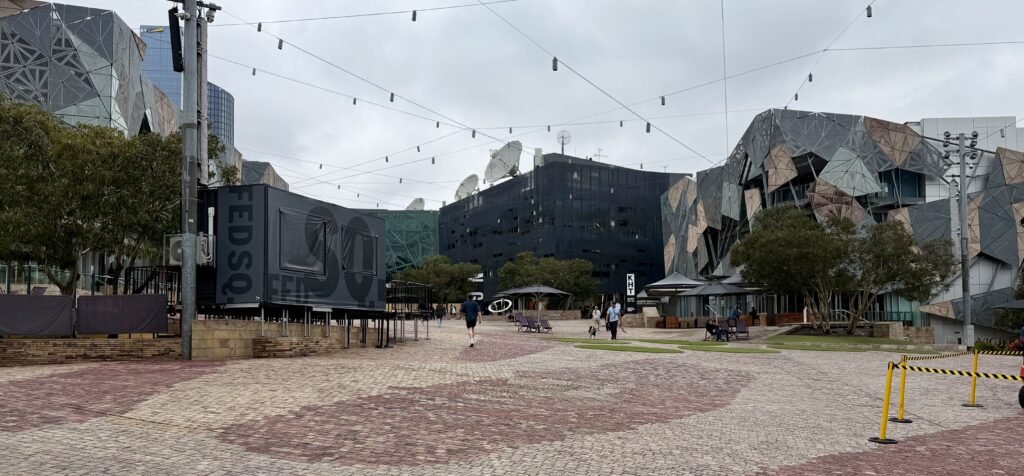
The architecture of Federation Square is designed in a deconstructivist style, featuring angular, irregular geometries instead of traditional straight grids. Notable buildings within the square include the Australian Center for moving Image (ACMI), the Birrarung Building, and the Ian Potter Centre, which is part of the National Gallery of Victoria (NGV).
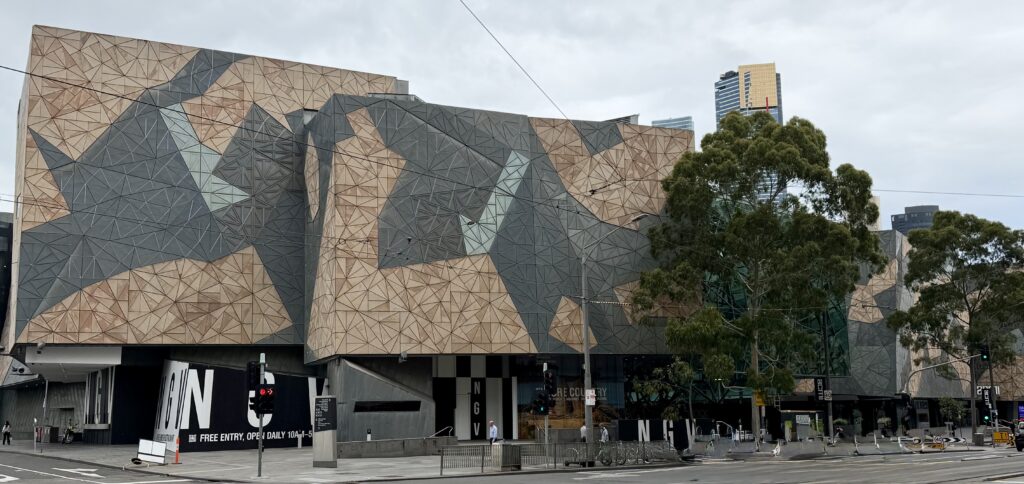
Federation Square, National Gallery of Victoria (Ian Potter Centre) – This gallery is free to enter and well worth 1–2 hours of exploration. Founded in 1861, it is Australia’s oldest and most visited art museum, with a collection of over 76,000 works. The Ian Potter Centre focuses on Australian art, while NGV International on St Kilda Road houses the gallery’s international collection.
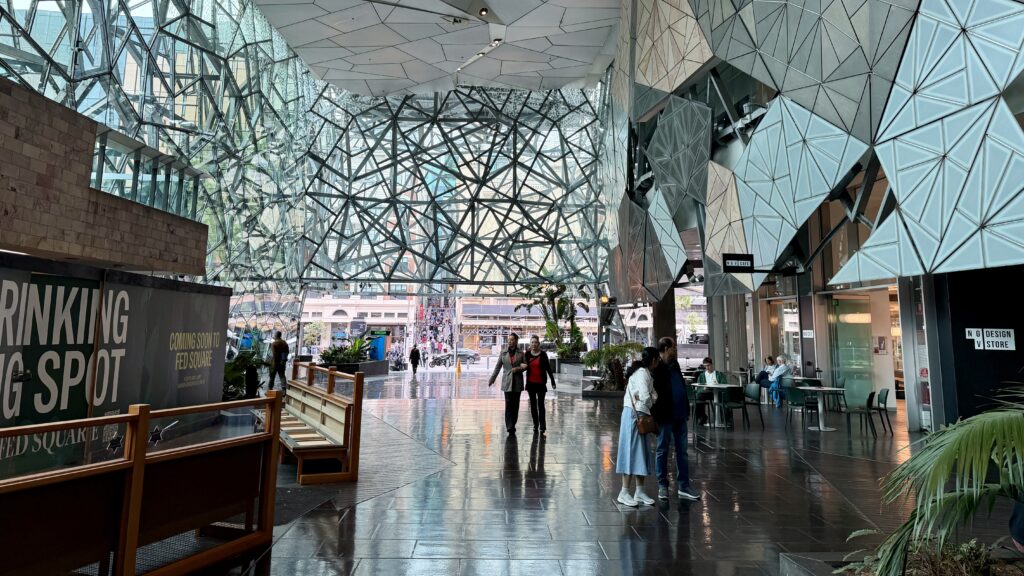
NGV Australia has a particular focus on Indigenous Australian art, and alongside the permanent displays presents temporary exhibitions relating to Australian art and history.
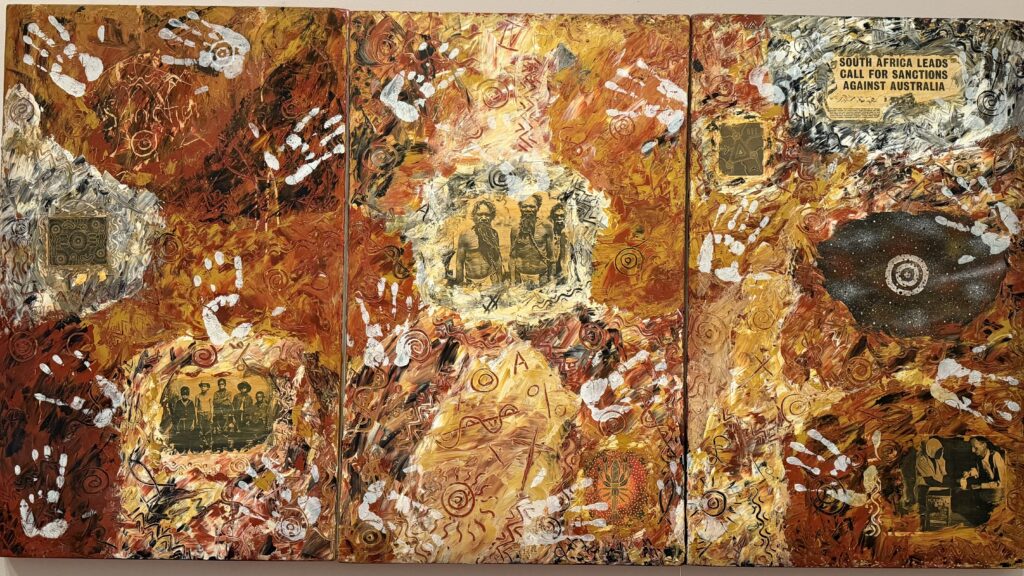
The Story Unfolds by Richard Bell – This painting consists of 3 panels joined by hinges each featuring layered painted and archival imagery that examines political themes including First Nations human rights and land rights in Australia. The work incorporates newspaper headlines from the past, circulating them in the present, as well as archival images of Aboriginal people in chains receiving rations while dressed in colonial English attire. The painting critiques colonialism, racism, and commercialization of Aboriginal art and culture.
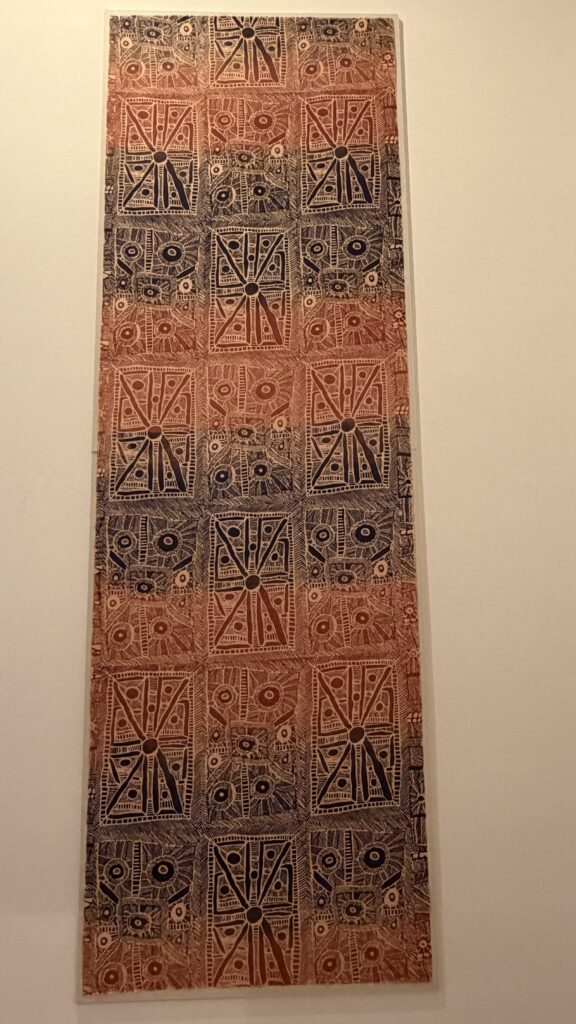
- Bark painting – is a traditional Aboriginal art form from Northern Australia, practiced for around 50,000 years. Artists use eucalyptus bark, carefully flattened and prepared, and natural ochres—reds, yellows, whites, and blacks—as pigments. The paintings often depict Dreamtime stories, ancestral beings, and clan symbols, and were originally ceremonial and educational, preserving cultural knowledge. Today, bark painting continues as a contemporary art form, displayed in galleries worldwide.
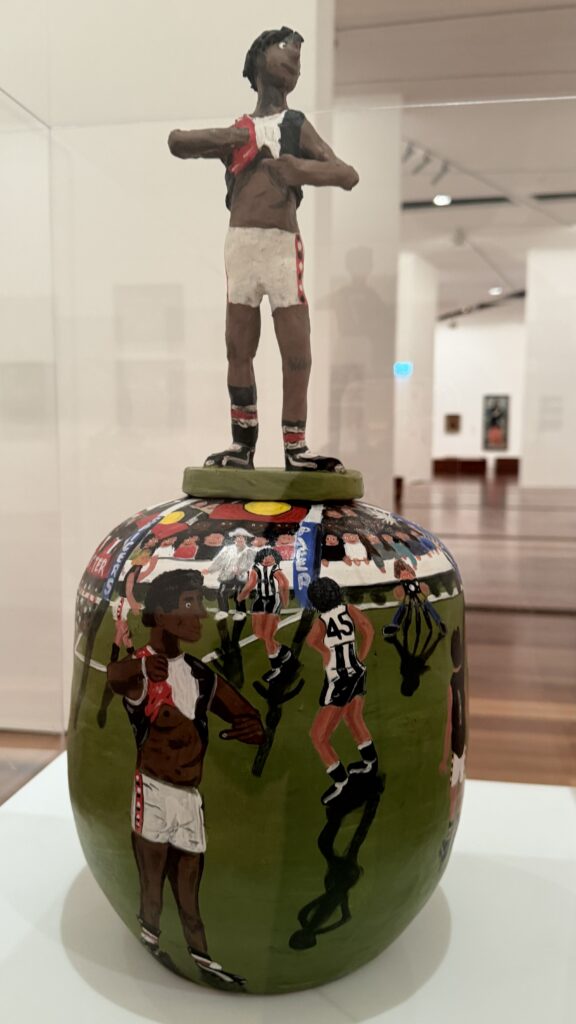
- I’m Black (Nicky Winmar) by Rona Panangka Rubuntja – This work celebrates legendary AFL star, Nicky Winmar, who in 1993 defiantly protested racial taunts by pointing to his skin color. His action held widespread attention across Australian media and called to action the ongoing issues of racism in Australian sports.
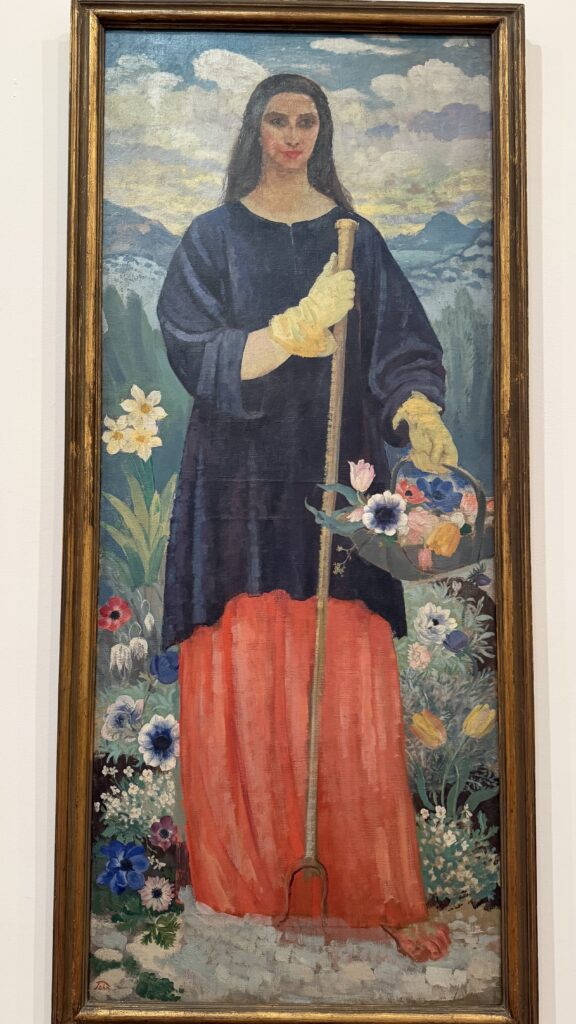
- The Beautiful Gardner by Augustus John – In this painting, Augustus john has alluded to Italian art of the 15th and early 16th centuries and to late 19th-century French symbolism, which he was fascinated by at that time. He gave the painting a French title, reinforcing the romantic nature of the work. The painting is not varnished, and its chalky appearance gives it the impression of being an Italian Fresco.
Federation Square, Australian Center for moving Image (ACMI) – Established in 2002, this free attraction is Australia’s national museum of screen culture, covering film, television, video games, digital culture, and art. It features curated exhibitions, a permanent exhibition called The Story of the Moving Image, as well as film screenings, events, a library, online collections, and educational programs. However, we were unable to explore it as it had closed by the time we arrived after spending over an hour at the NGV.
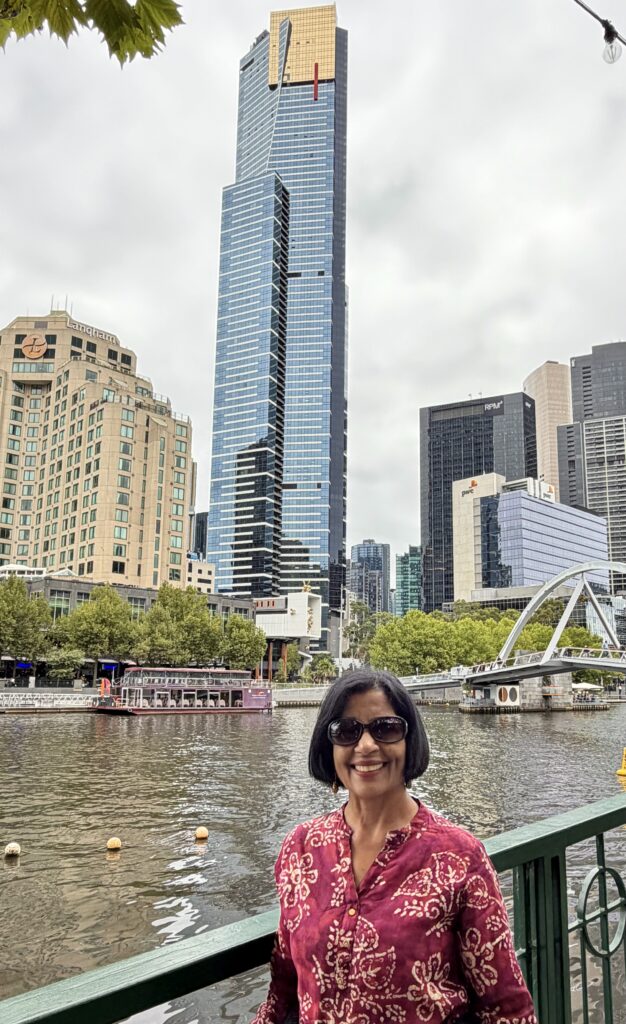
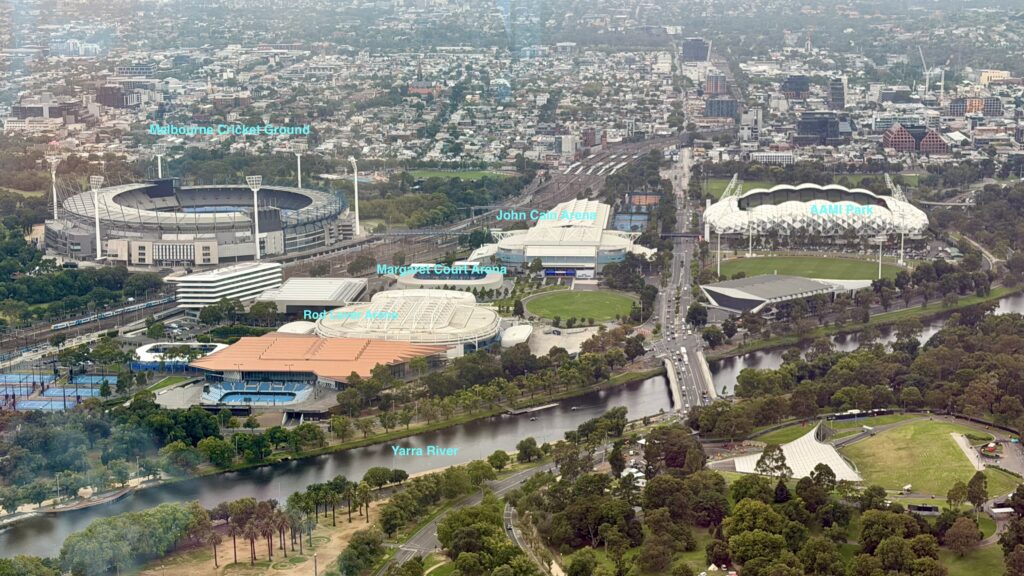
Eureka Tower (Melbourne Skydeck) – is a 297 m (975 ft) skyscraper in Melbourne’s Southbank, and is one of the city’s most iconic landmarks. Completed in 2006 and designed by Fender Katsalidis Architects, it contains 556 apartments and features 13 lifts. The 88th floor Skydeck is the highest public observation point in the Southern Hemisphere, offering spectacular city views and landmarks. Thrill-seekers can try The Edge, a glass cube extending 3 m over the tower.
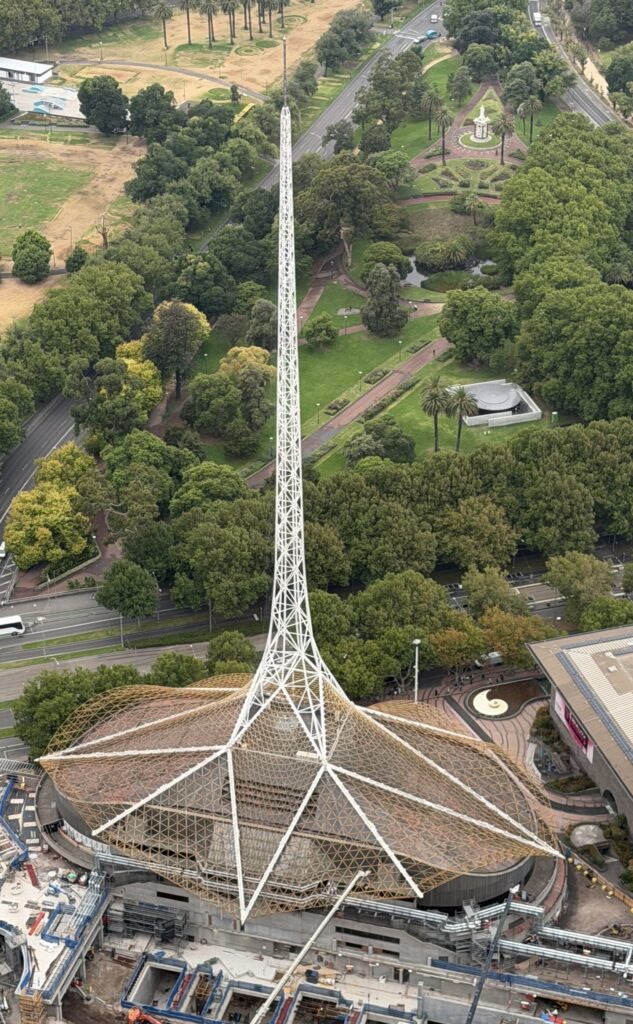
We purchased our tickets at the counter, which offers several options, and chose the General Skydeck + Edge Experience for AU$55 per person. The view from the top was amazing, especially of the city’s sports arenas, the spire of Arts Centre Melbourne, Yarra River, and Parliament building.
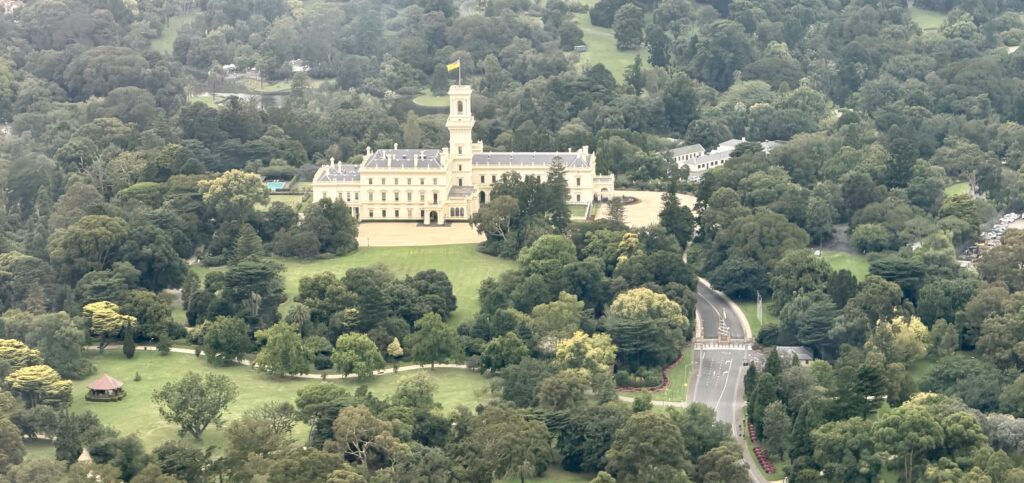
Government House – We got a good view of this building from the Skydeck of the Eureka Towers. It is the official residence of the Governor of Victoria, and is located in Kings Domain next to the Royal Botanic Gardens. Opened in 1876, it was designed by William Wardell in the Italianate style, inspired by Queen Victoria’s Osborne House. From 1901 to 1930, Government House served as the residence of the Governor-General of Australia when Melbourne was the temporary national capital during Canberra’s construction. It was returned to the Victorian government after the Governor-General moved permanently to Canberra.
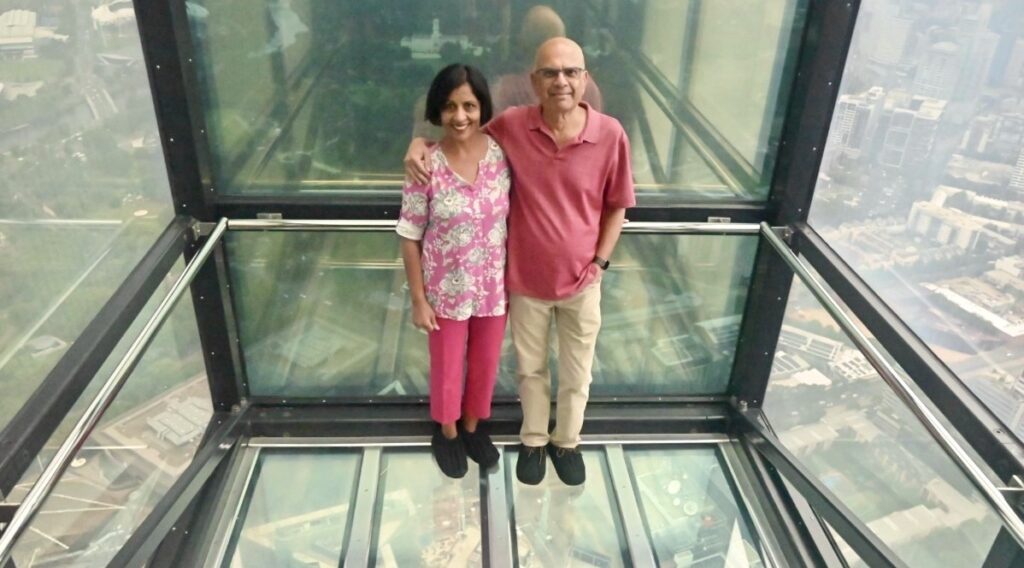
The Edge Experience was enjoyable but not particularly thrilling, and the free photos taken felt underwhelming.
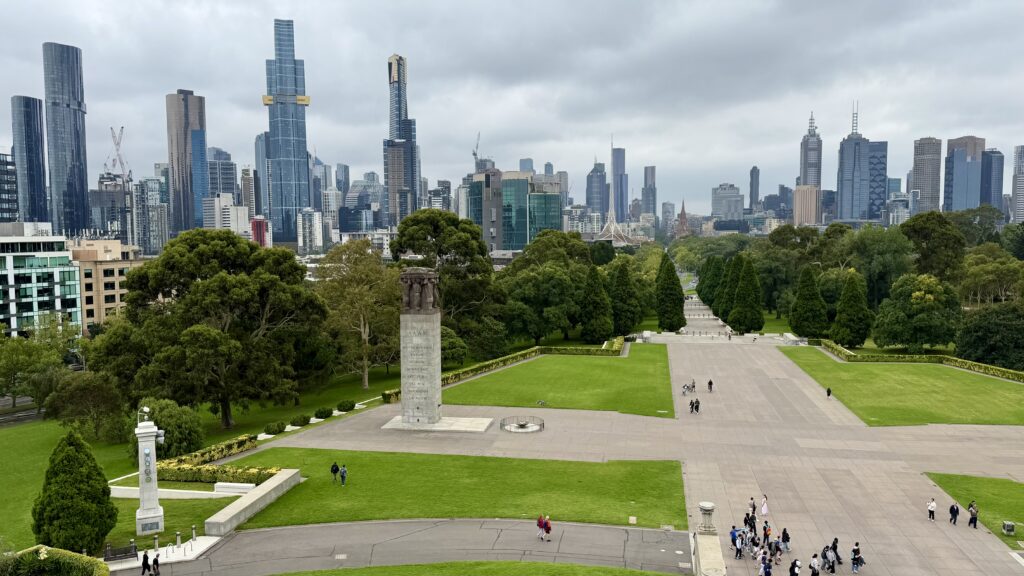
Shrine of Remembrance – We then met up with my husband’s schoolmate who lives in Melbourne. He drove us to Shrine of Remembrance. Opened in 1934, the Shrine of Remembrance honors Victorians who served in World War I and now commemorates all Australians who have served in any war.
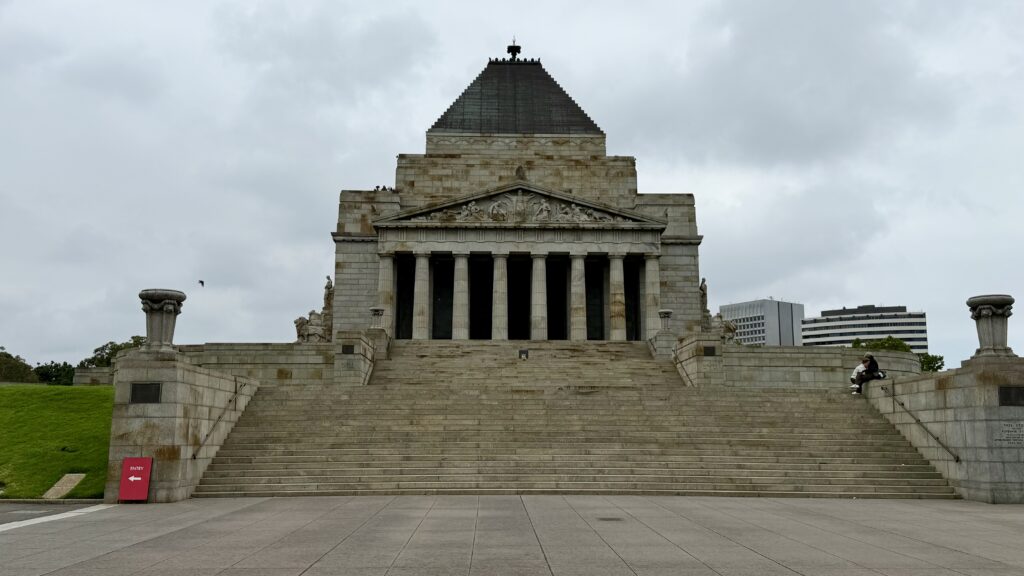
We spent 40 minutes walking around the peaceful complex. The visitors center had stairs to climb up to the balcony from where you get a great view of the shrine grounds and some city view.
Phillip Island and Parade of the Penguins – Located about 142 km from Melbourne, Phillip Island is home to the largest little penguin colony in the world. You can experience the magic of watching these amazing seabirds waddle home from the ocean to their burrows daily after sunset from viewing platforms and boardwalks. Our friend drove us to the island, which took about two hours to reach. On the way, we stopped for lunch in the town of Clayton, which offered a wide variety of restaurants, and we chose one that served a selection of Indian street food.
We reached the island by 6:30pm and bought the tickets for the show. There are several ticket options available –
- General Admission – $33
- Premier – $85
- Premier Plus – $90
- Underground – $100 – Encounter the little penguins on their level as you peer directly at them waddling right by on the famous ‘penguin highway’. In a comfortable and sheltered area.
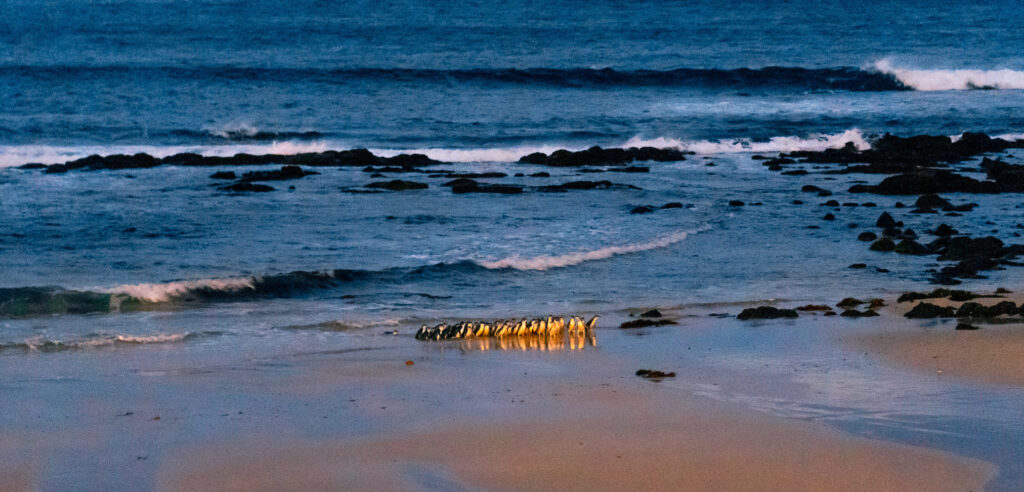
We bought the Premier Plus tickets, which gave us one of the best viewing spots to see the maximum number of penguins walk out of the water and head toward the boardwalk where we were seated. On the day, we visited the penguins were scheduled to appear at 8:20pm and they kept the schedule. We were not allowed to take pictures or videos at the site, but allowed to download them from the official website.
We were seated in our viewing area by 7:30pm to watch the sunset. Since it was a cloudy and rainy day, we didn’t get to watch the sunset. However, we were able to witness the amazing sight of penguins coming out of the water after sunset and parading back to their burrows. After they come out of the water, some penguins sprint across the beach toward the boardwalk, while others take their time and slowly waddle across the sand. After watching a few groups make their way across, we walked back to the entrance along the boardwalk, accompanied by the calls of the penguins.
————— Day 2 —————
Melbourne Cricket Ground Tour – We started Day 2 of our Melbourne trip with a guided tour of the MCG, which we had booked online a month in advance. The tour began at Gate 3, about a 30-minute walk from our hotel, and was easy to locate. Lasting a little over an hour, the guide took us through various levels of the stadium, including the players’ changing rooms, dining area, gym, press room, and team planning spaces.
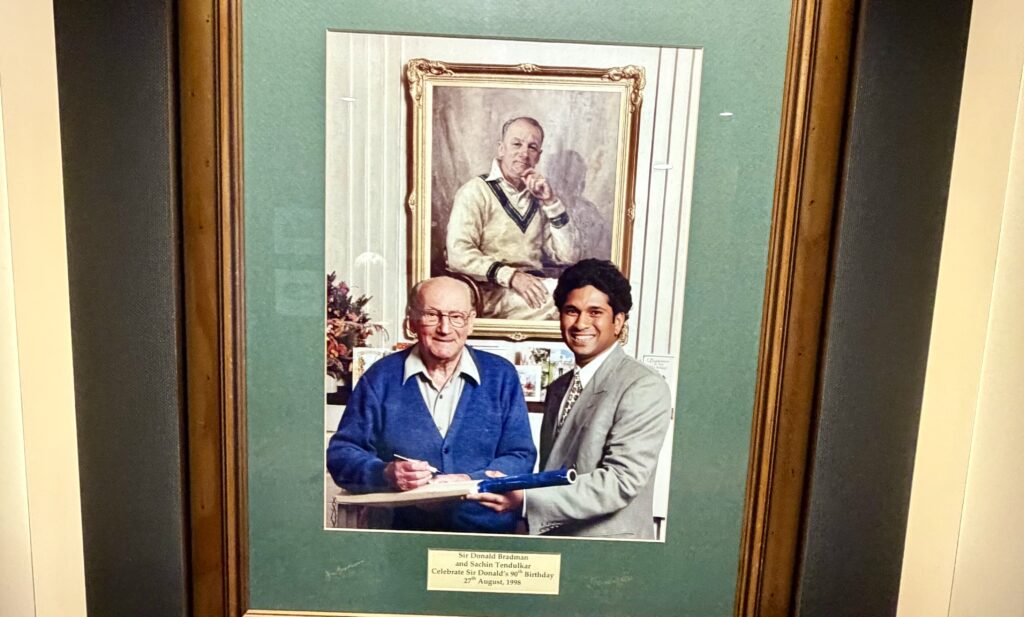
After the tour, we spent an additional 30–45 minutes exploring the sports museum. One of the highlights was the famous photograph of Australian legend Sir Don Bradman with Indian great Sachin Tendulkar, taken on Bradman’s 90th birthday.
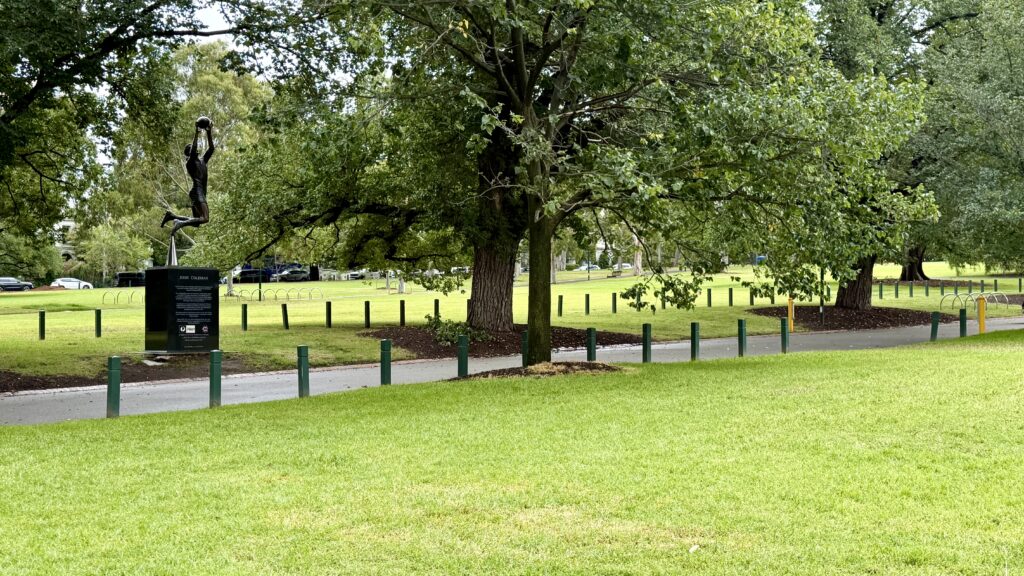
Yarra Park – After touring MCG, we walked through Yarra park which surrounds Melbourne Cricket Ground (MCG). The park features numerous statues of cricket legends like Dennis Lille, Shane Warne, Neil Harvey etc. The park also features tree-lined paths, open lawns, and footbridges connecting visitors to nearby venues and the Yarra River Trail.
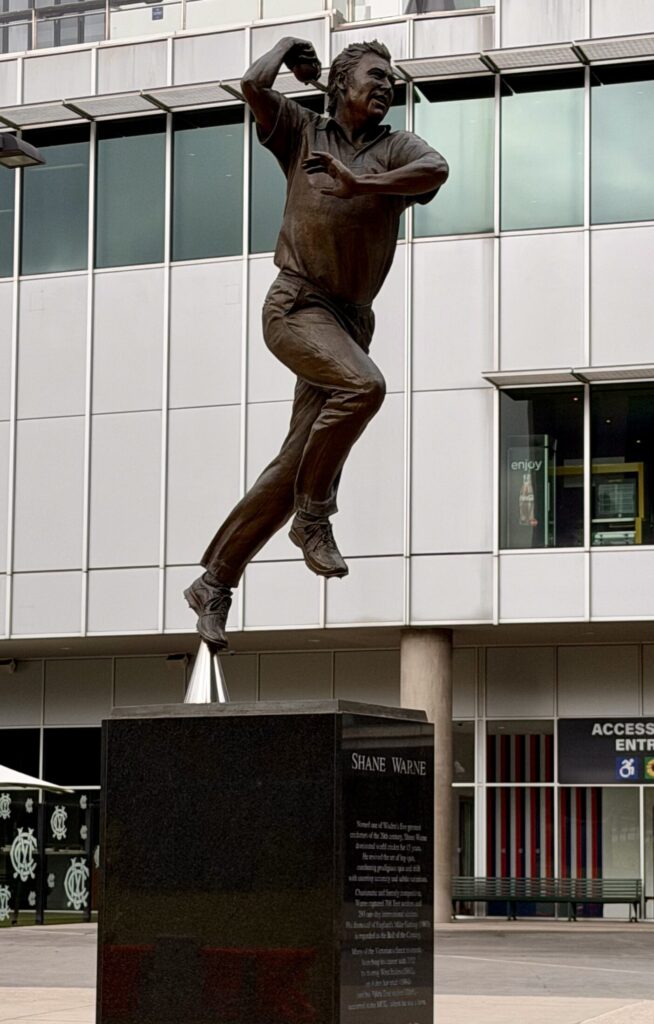
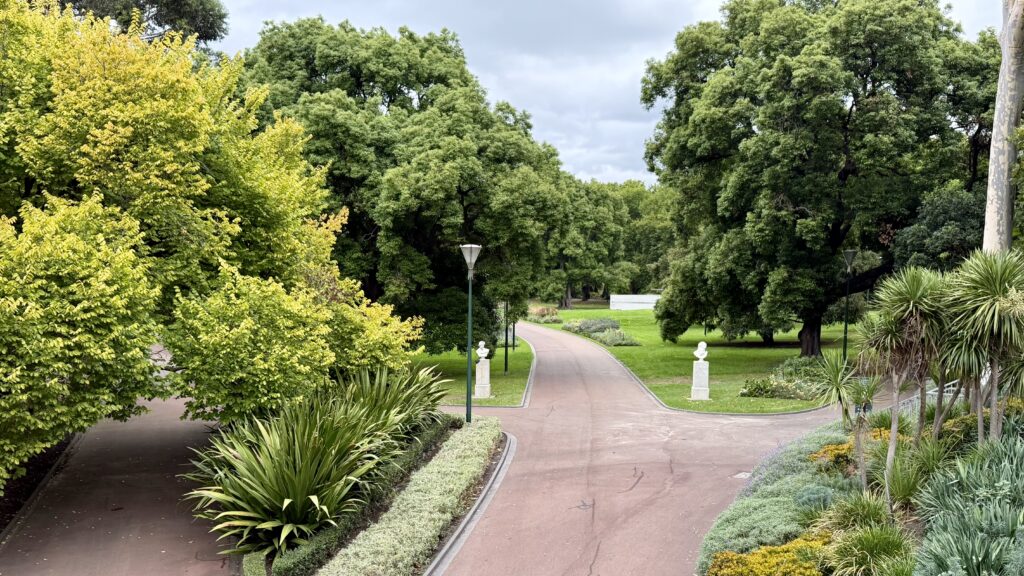
Fitzroy Garden – Located next to Yarra Park, we took a leisurely stroll through these beautiful gardens, spending time admiring the well-maintained flower displays, a man-made waterfall, and Captain Cook’s Cottage.
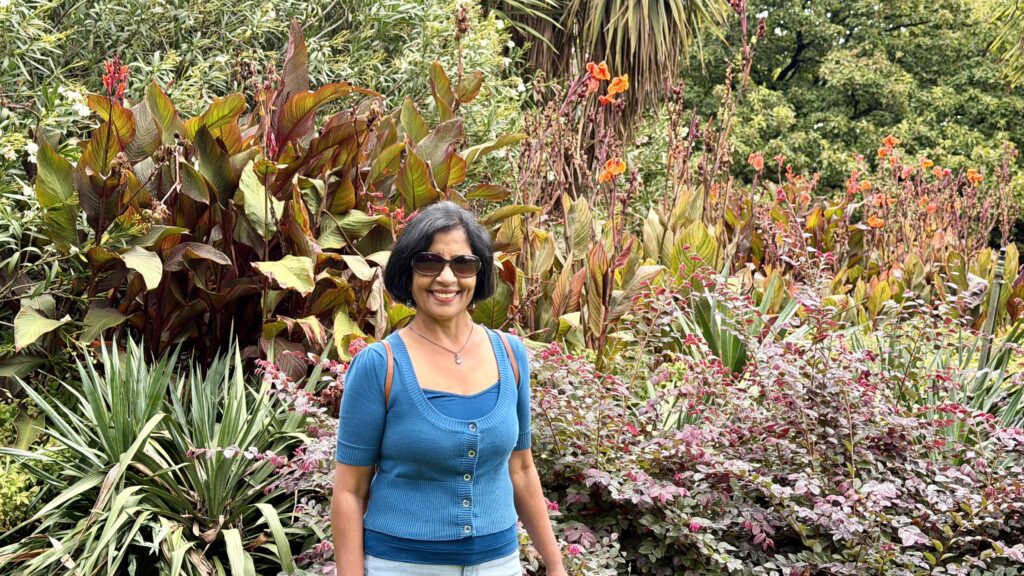
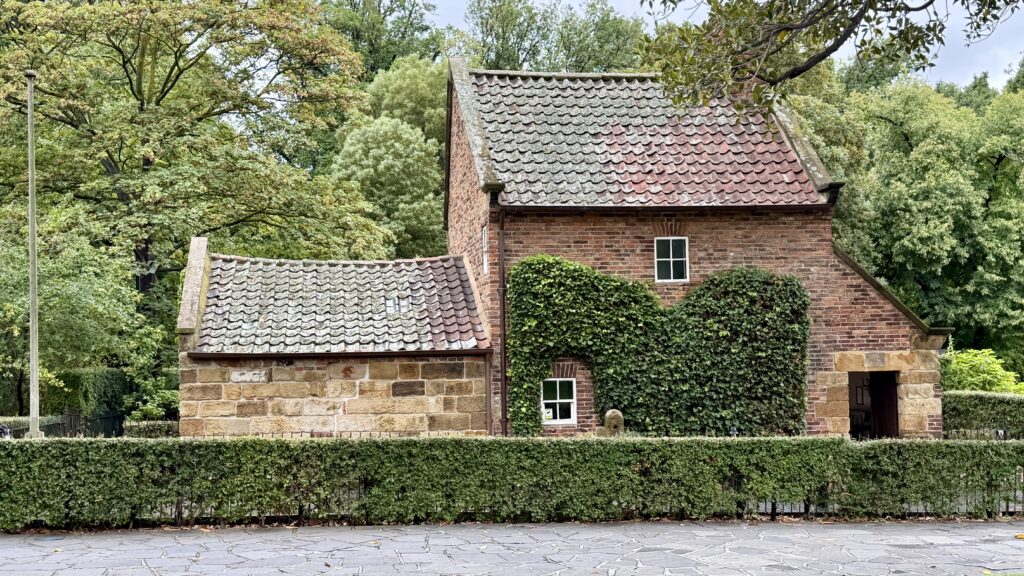
Fitzroy Garden, Captain Cook’s Cottage – located in Fitzroy Gardens, it was originally built in 1755 in Great Ayton, England, by the parents of Captain James Cook. Although it is uncertain whether Cook ever lived there, he likely visited. The cottage was transported to Melbourne in 1934 by philanthropist Sir Russell Grimwade. Today, its interior is styled to reflect the 18th century, featuring period furnishings (mostly not original), and is often presented by guides in historical costume.
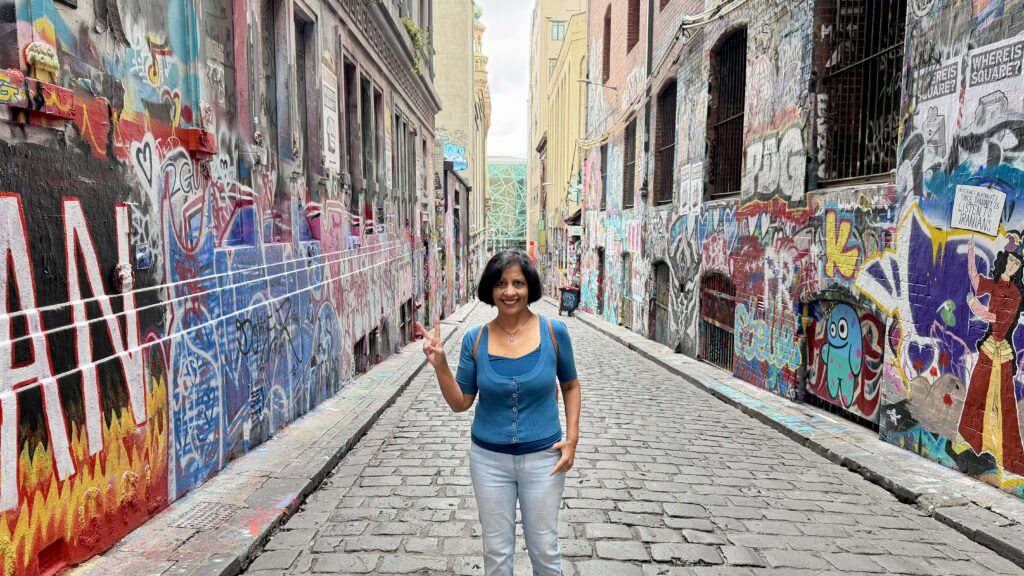
Street art on Hosier Lane – This street was our next stop. Located in Melbourne’s central business district (CBD), the lane is named after local businessman Robert Hosier, and has become a popular tourist attraction since the late 1990s due to its vibrant street art.
The lane operates as a free-to-paint area, with no permits required. Opened as a street art gallery in 1998 by the City Lights Initiative, it is known for high-quality, often political artwork. Hosier Lane is featured in The Melbourne Design Guide and Tourism Victoria campaigns, and its graffiti-covered walls are frequently used for fashion and wedding photography. We strolled the entire length of the street, stopping to admire the colorful artwork.
Block Arcade – is a historic shopping arcade in Melbourne’s central business district, constructed between 1891 and 1893. Designed by architects Twentyman & Askew, it is celebrated as one of the finest examples of late Victorian architecture and a popular tourist attraction. The arcade features an L-shaped layout with an octagonal rotunda, mosaic-tiled floors, a glass canopy supported by cast and wrought iron, and elaborate timber shopfronts.
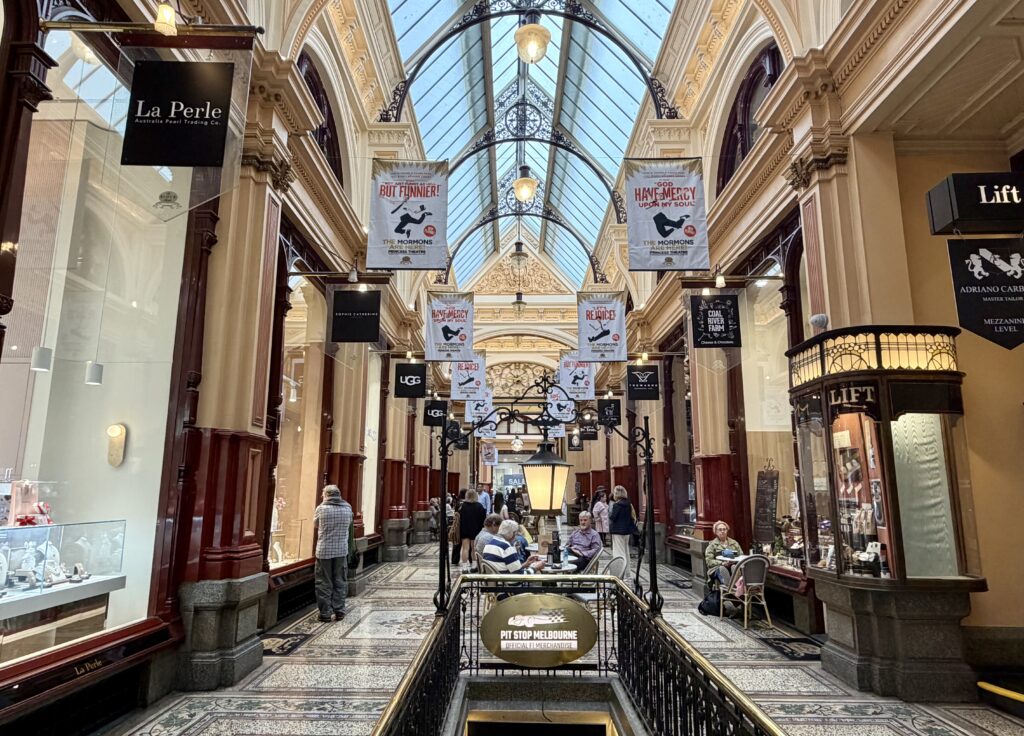
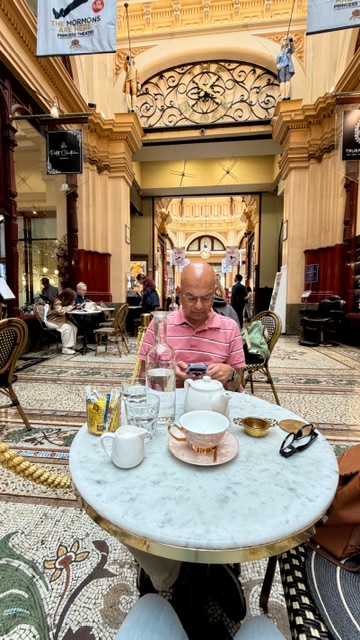
Royal Arcade – Located within walking distance of Block Arcade, this place is another historic shopping arcade in Melbourne’s central business district, opened in 1870 and designed by Charles Webb. It is Australia’s oldest surviving arcade and is famous for its light-filled interior, elegant bow-fronted shopfronts, and the large carved mythical figures Gog and Magog at the southern entrance, which strike bells each hour via the Gaunt’s clock.
Over the years, the arcade has seen several modifications, with a major restoration from 2002 to 2004 that recreated the 1894 shopfronts and refreshed the facade in a yellow-and-white color scheme with gilded highlights.
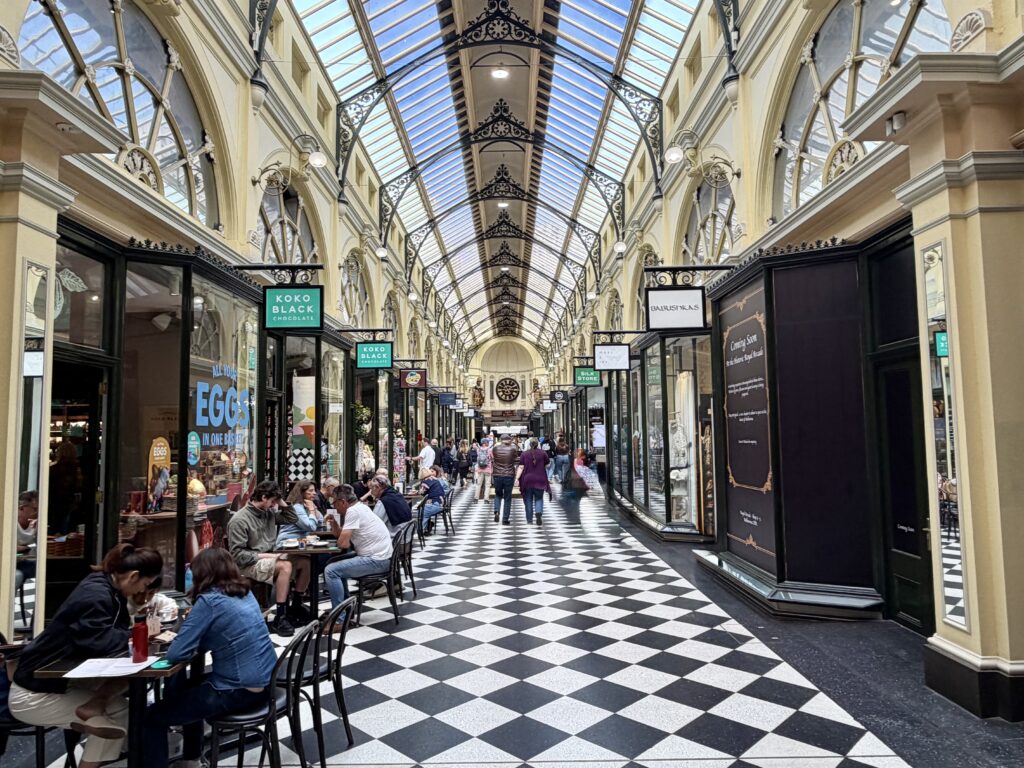
Royal Arcade is smaller than the Block Arcade but equally charming with its entrance on Bourke Street.
Shop in Queen Victoria Market – is a major public marketplace in Melbourne’s CBD, covering over seven hectares, making it the largest open-air market in the Southern Hemisphere. Constructed in stages from the 1860s and officially opened in 1878, it is the last major market remaining in the CBD and one of the few Victorian-era markets still operating, alongside Prahran Market and South Melbourne Market.
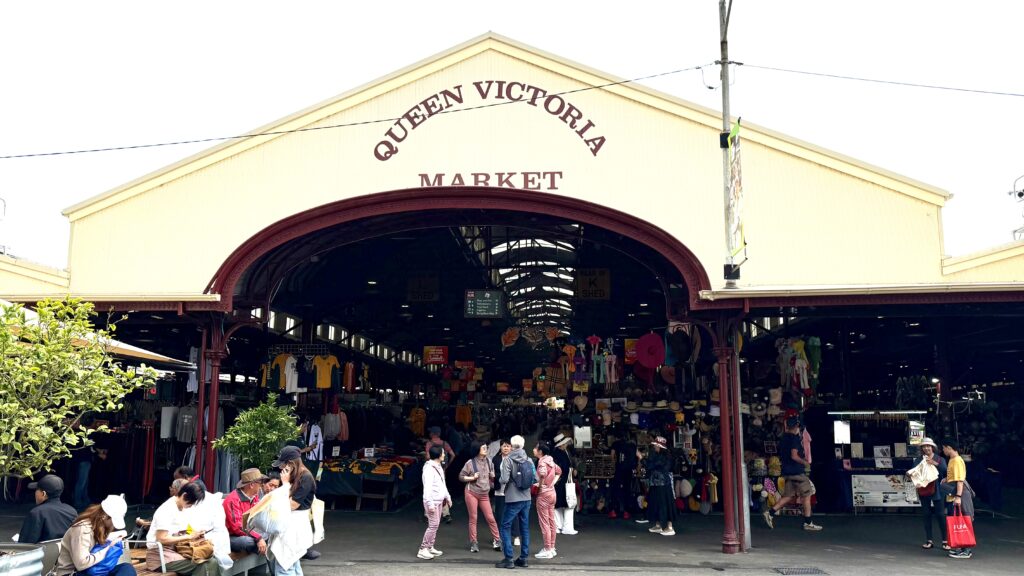
The market was built over the site of the Old Melbourne Cemetery, Melbourne’s first British burial ground, which included the grave of city founder John Batman. The cemetery officially closed in 1854.
State Library Victoria – The main reason for visiting this library is because of its stunning interior. This state library of Victoria was established in 1854 as the Melbourne Public Library. It is Australia’s oldest public library, and one of the first free libraries in the world.
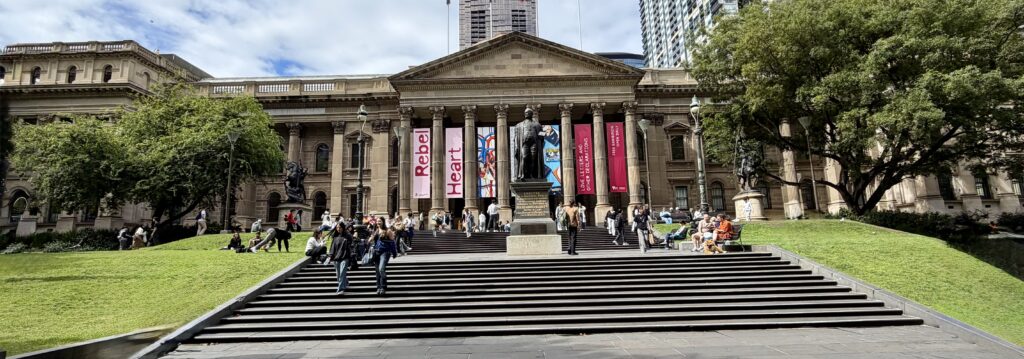
The interior of the library is stunning and grand, reflecting its 19th-century heritage. The centerpiece is the La Trobe Reading Room, a magnificent domed circular space with soaring ceilings, elegant columns, and soft natural light streaming through the skylight. The room’s classical design, with rows of polished wooden desks and intricate detailing, creates an inspiring atmosphere for study and reflection.
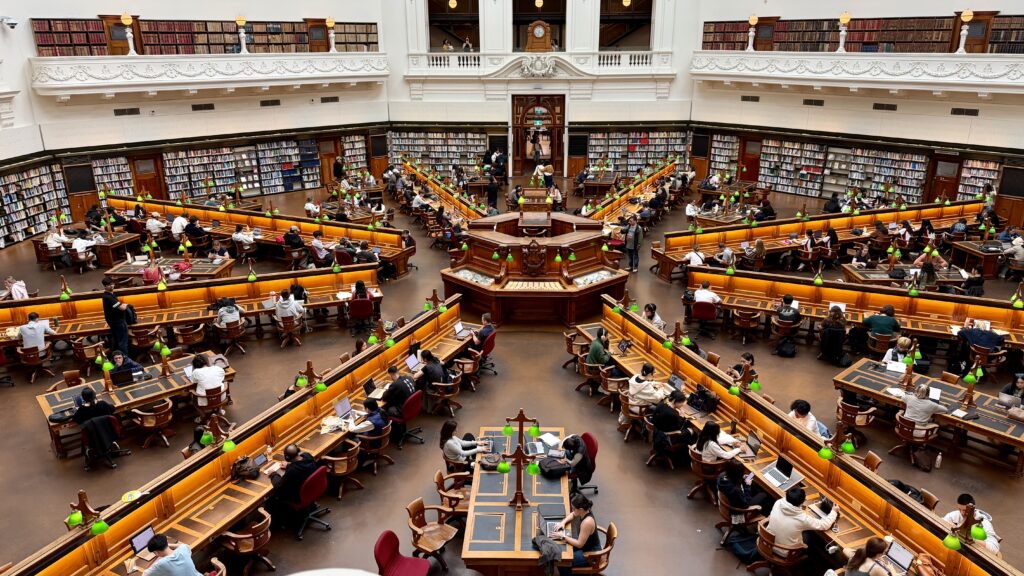
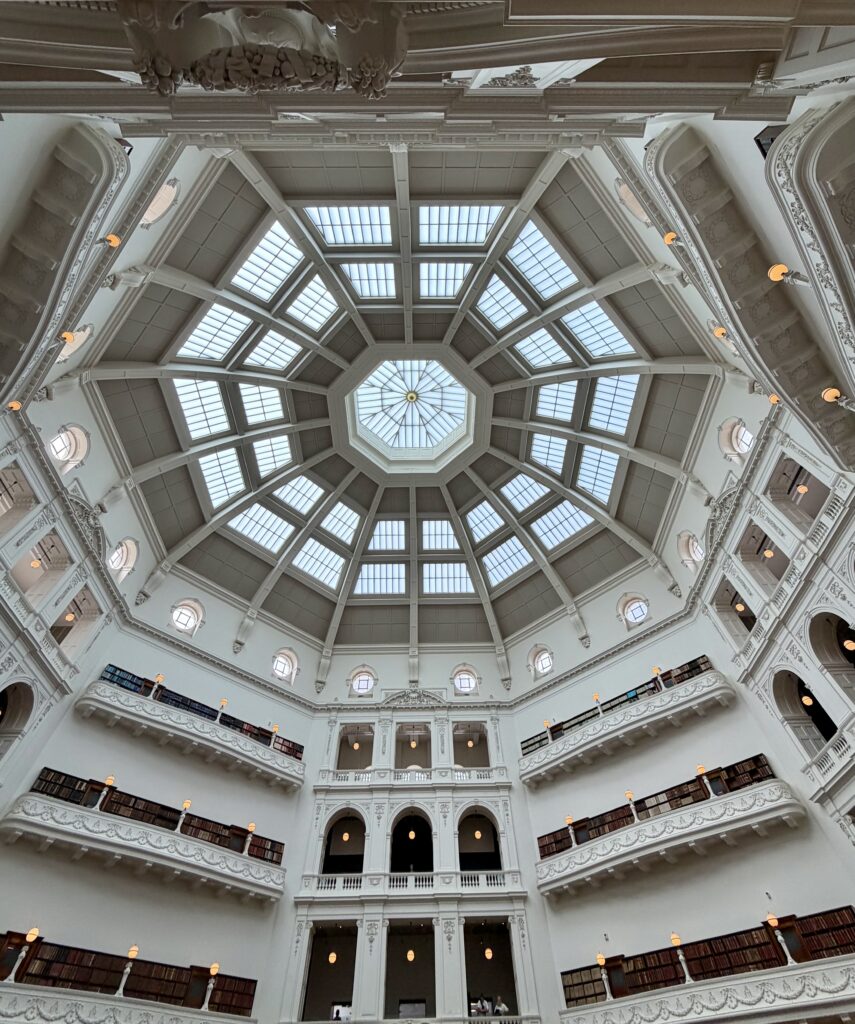
Other areas of the library feature spacious galleries, ornate staircases, and beautifully preserved 19th-century architectural elements, making the library not just a center for knowledge but also a visual and cultural treasure in Melbourne.
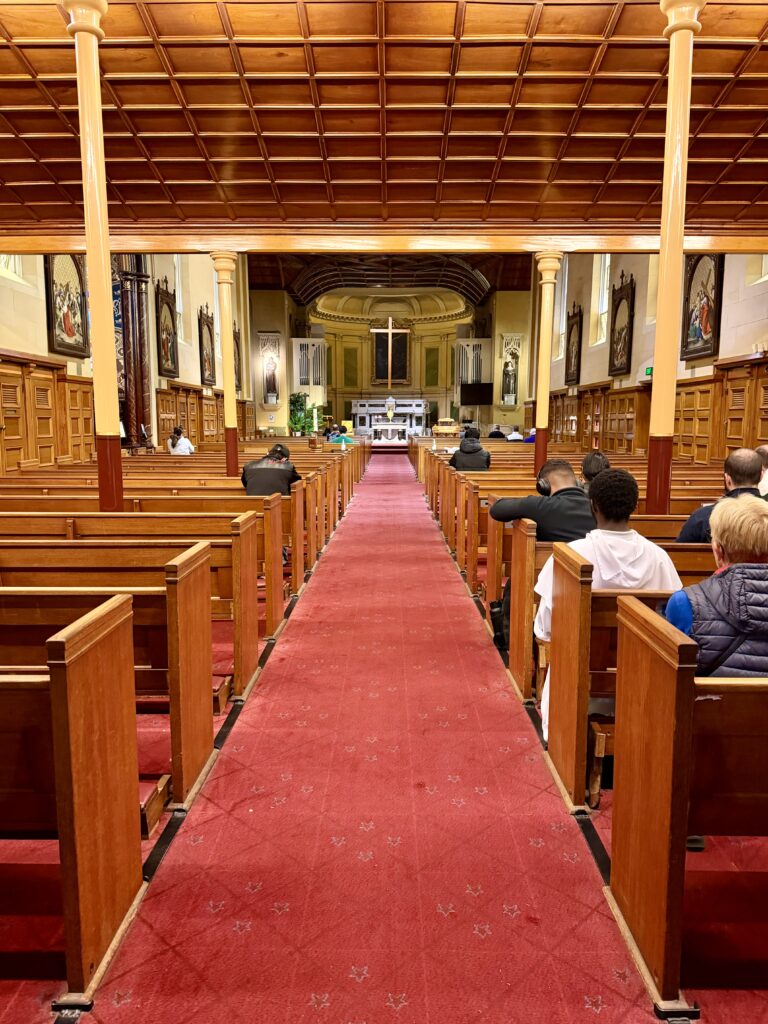
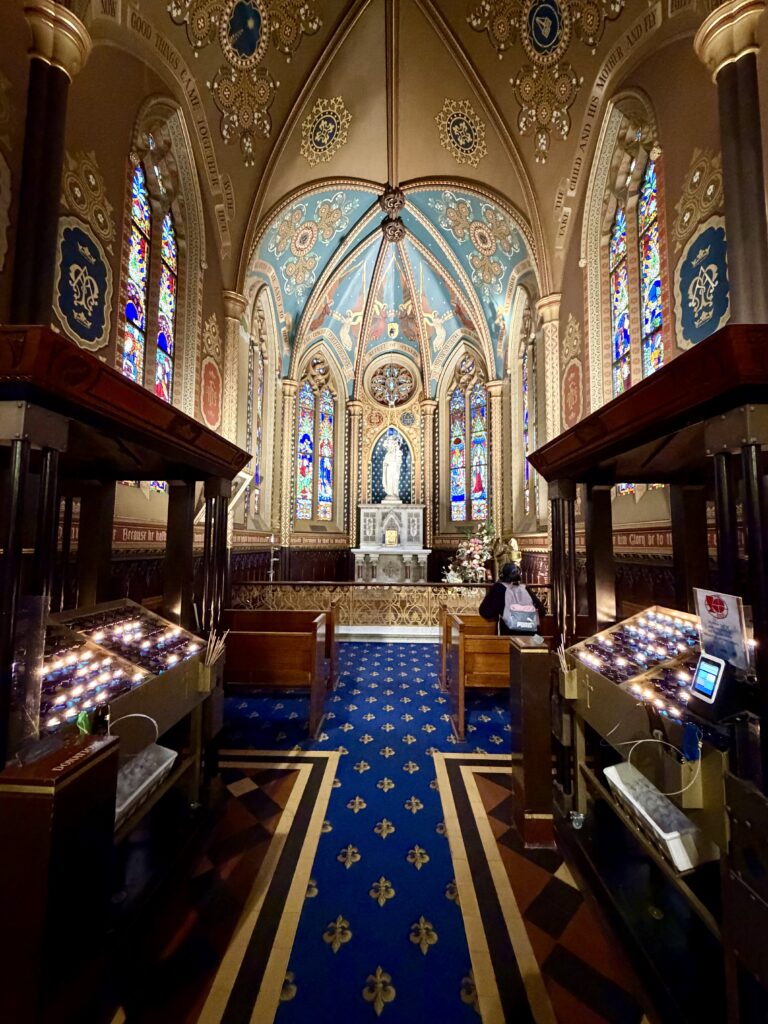
St Francis’ Church – located at the corner of Lonsdale and Elizabeth streets in Melbourne, it is the oldest Catholic church in Victoria and one of the few buildings in central Melbourne predating the Victorian gold rush of 1851. The church’s foundation stone was laid on 4 October 1841, and the first Mass was held in May 1842.
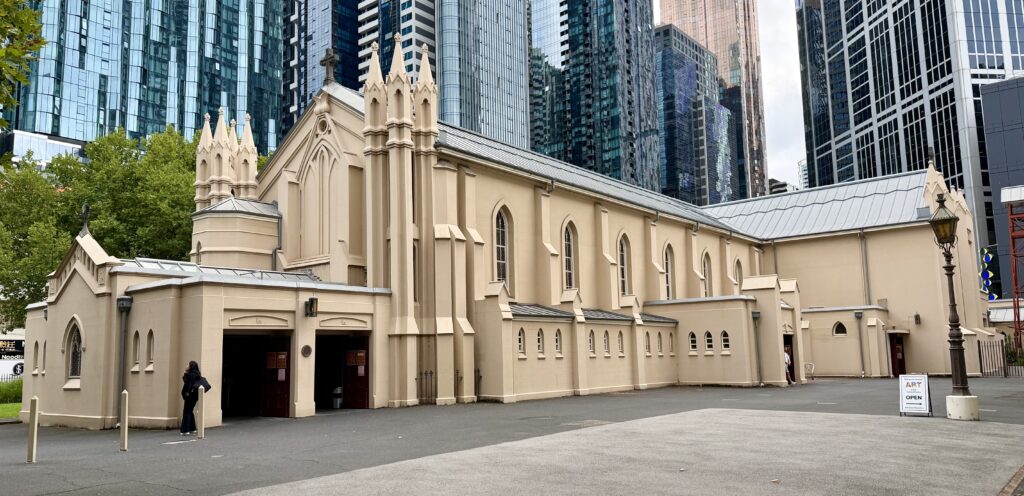
St Francis’ served as the cathedral for Melbourne’s first Catholic bishop, James Goold, from 1848 until 1868, when the diocesan seat moved to St Patrick’s Cathedral. Notable features include the cedar ceiling (installed in 1850) and the ornate Ladye Chapel (1856–1858), designed by George and Schneider with decoration by Le Gould and Souter.
————— Day 3 —————
Carlton Gardens – We started our day at this UNESCO World Heritage Site located on the northeastern edge of Melbourne’s CBD in Carlton. Spanning 26 hectares, the gardens include major attractions like the Royal Exhibition Building, Melbourne Museum, and IMAX Cinema, along with tennis courts and an award-winning playground.
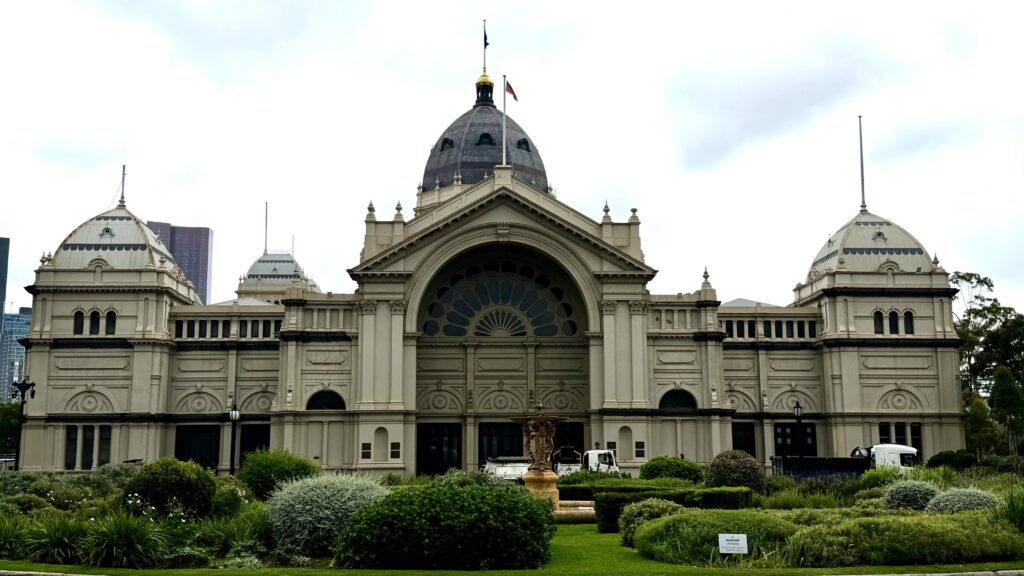
Carlton Gardens, Royal Exhibition Building – became Australia’s first UNESCO World Heritage-listed building in 2004. Built between 1879 and 1880 for the Melbourne International Exhibition, it later hosted the Centennial International Exhibition in 1888 and played a key role in Australia’s history as the site of the Federation of the Commonwealth of Australia in 1901.
Reflecting Melbourne’s prosperity in the late 19th century, the building is one of the world’s last remaining major exhibition structures from that era, with its central Great Hall still intact despite partial demolitions and fires over time. In 1980, it was granted the title Royal by Queen Elizabeth II, and today, it hosts exhibitions and events and is closely associated with the nearby Melbourne Museum.
Carlton Gardens, Melbourne Museum – located next to the Royal Exhibition Building, the museum is a natural and cultural history museum that opened in 2000. Its extensive collection includes over 17 million items, covering Indigenous cultures, geology, paleontology, zoology, technology, and history.
Carlton Gardens, IMAX Melbourne – is a major IMAX theatre opened in 1998 with a screening of Everest. Located beside the Melbourne Museum, it is the largest IMAX theatre in the Southern Hemisphere and features the world’s largest screen, along with advanced dual laser and 1570 film projection systems.
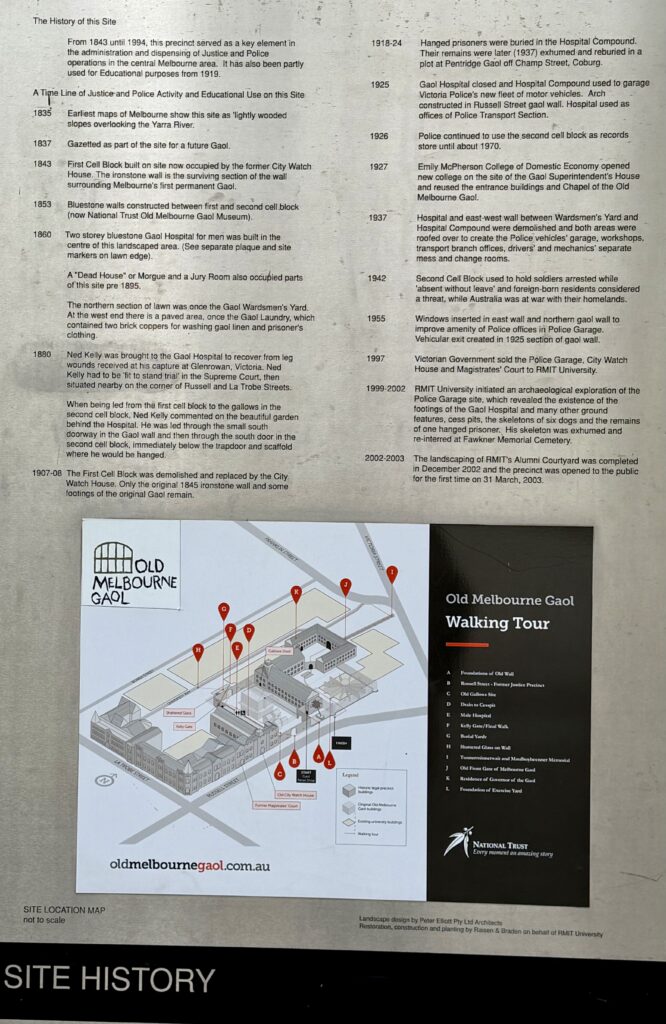
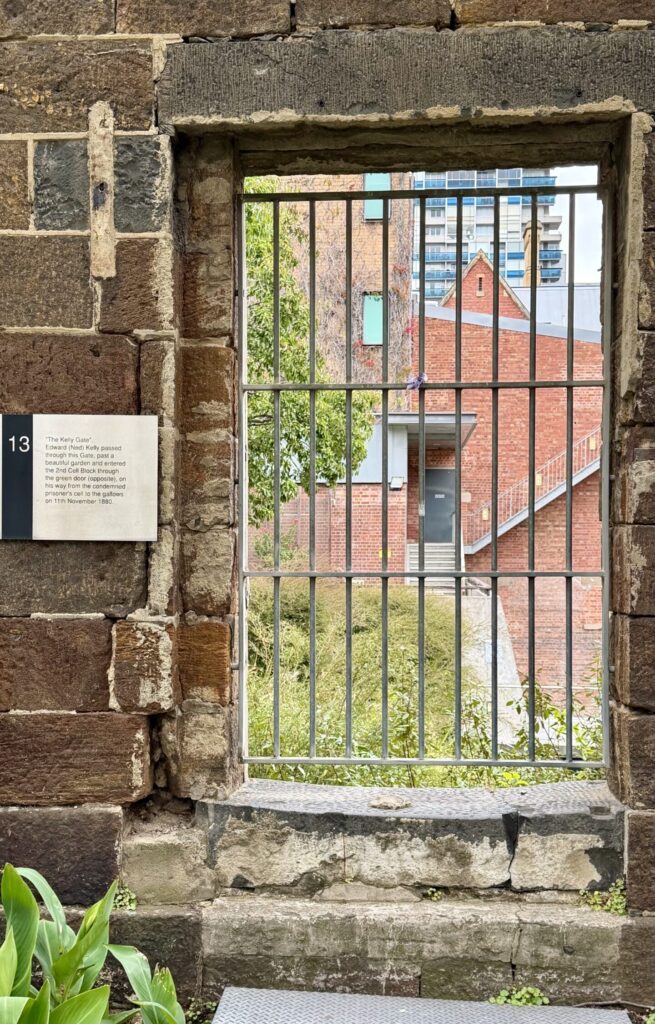
Old Melbourne Goel – is a former prison, now a museum. Built starting in 1839 and operating from 1845 to 1924, it housed and executed some of Australia’s most notorious criminals, including Ned Kelly and Frederick Bailey Deeming, with a total of 133 executions by hanging.
After closing as a prison, parts of the site were incorporated into RMIT University, while the rest became a museum. Today, the three-storey museum displays prisoner memorabilia, staff history, and artifacts such as death masks, along with items linked to famous inmates.
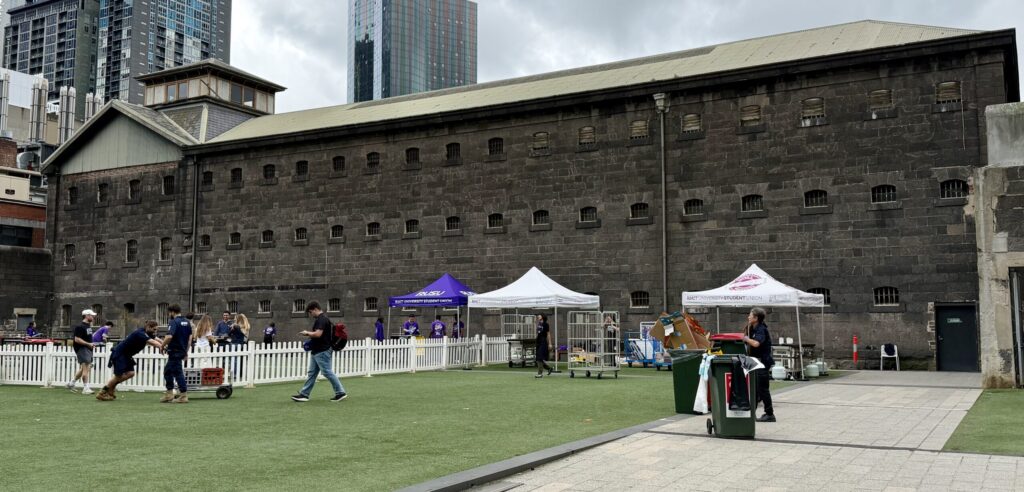
We spent about 45 minutes walking around the outside, reading the information displays. We chose not to do the self-guided tour inside as we found it a bit pricey, and we were already planning to visit the penitentiary in Tasmania.
Yarra River (Birrarung or river of mists) – is a 242-km river in the state of Victoria, Australia, flowing from the Yarra Ranges through Melbourne’s CBD into Hobsons Bay. It plays a central role in Melbourne’s culture, offering scenic views, recreation, and supporting wildlife and industry. Since Melbourne’s founding in 1835, parts of the river have been modified, especially near the Port of Melbourne.
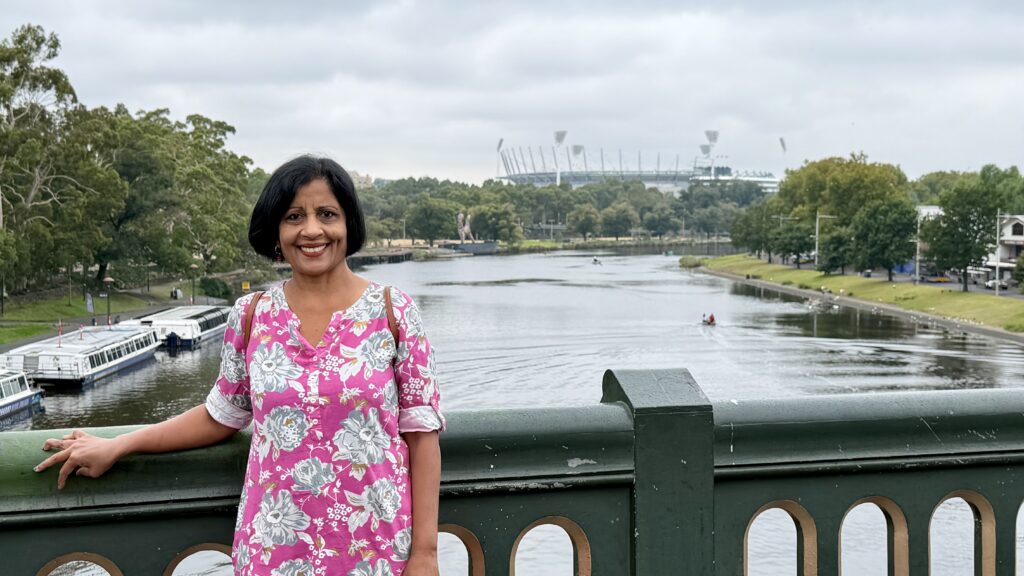
Yarra River walk in Melbourne offers scenic, pedestrian-friendly pathways, ranging from a 3.5 km central city loop to a 38 km regional trail, with easy access to attractions like Federation Square, the Crown Complex, and the MCG. We started our walk at Federation Square and strolled along the river all the way to Sandridge Bridge, crossing over to the other side.
Sandridge Bridge is a historic structure, originally built to carry railway lines. The current bridge, about 178 metres long, was redeveloped in 2006 and now serves as a pedestrian and cycle path, featuring striking public art installations. We ended the day with dinner at a Greek restaurant along the promenade—fitting, as Melbourne is home to the largest Greek population outside of Greece.
Alexandra Gardens – Named in honor of Queen Alexandra and located on the south bank of the Yarra River, in the vicinity of Federation Square and Melbourne’s CBD, Alexandra Gardens is a scenic green space perfect for a relaxing stroll. Laid out in 1901, the gardens are part of the larger Domain Parklands, which also include the Royal Botanic Gardens, Kings Domain, and Queen Victoria Gardens.
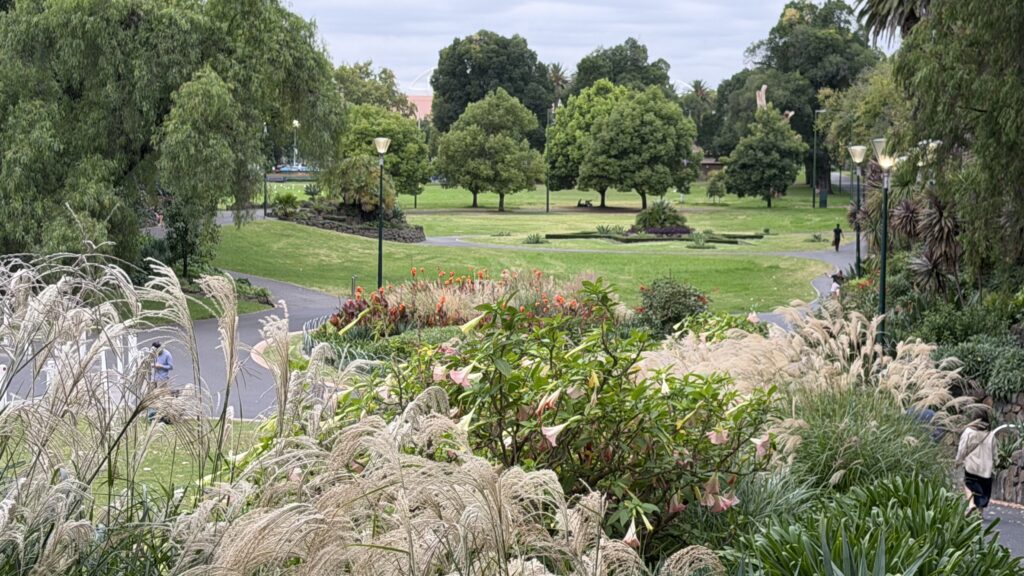
Queen Victoria Garden – Located next to Alexandra Garden (see above section), Queen Victoria Gardens were created as a memorial to Queen Victoria after her death in 1901. The gardens feature ornamental lakes, lawns, rose gardens, and a statue of the Queen. The gardens are part of the larger Domain Parklands, which also include the Royal Botanic Gardens, Kings Domain, and Alexandra Garden.
Embrace Melbourne’s Coffee Culture – Melbourne is famous for its vibrant coffee culture, and Melburners really take their coffee seriously. Cafés are everywhere—from bustling laneways in the CBD to quiet suburban streets. Coffee here is more than a drink; it’s a lifestyle. Locals enjoy their coffee while brunching, socializing, or people-watching.
Yarra River Cruise – is a relaxing way to see Melbourne from a different perspective. Drifting along the river, you can admire the city skyline, iconic bridges, and riverside attractions like Federation Square, the Crown Complex, and Southbank. There are several companies offering Yarra River sightseeing and special event cruises departing from Federation Wharf, so you have plenty of options if you want to experience the city from the water.
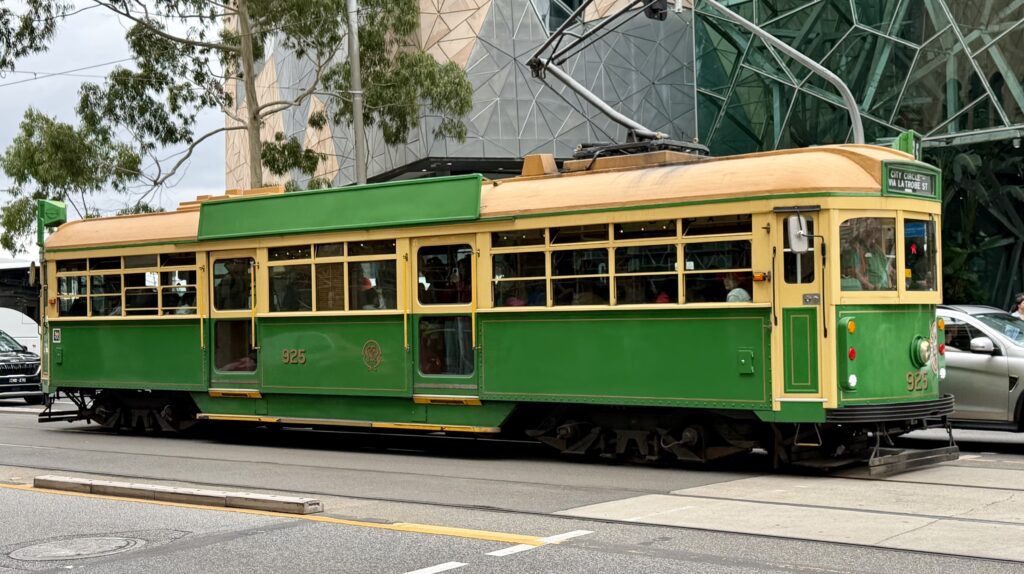
Ride the city Circle Tram – Melbourne is a very walkable city, with most major attractions just a few minutes apart. We explored much of it on foot, but the City Circle Tram is a fun and convenient way to get around. The free tram loops around the CBD, stopping near landmarks, historic sites, and cultural hubs. For destinations further out, regular tram routes and rideshare services like Uber make getting around easy and stress-free.
Interesting Buildings Along the Way – As you wander around Melbourne, you can’t help but notice the city’s stunning architecture. From historic churches to striking office buildings, each corner offers something unique that makes you pause and wonder about its history. Exploring on foot means you won’t miss these hidden gems, giving you a deeper appreciation of Melbourne’s rich architectural and cultural heritage.
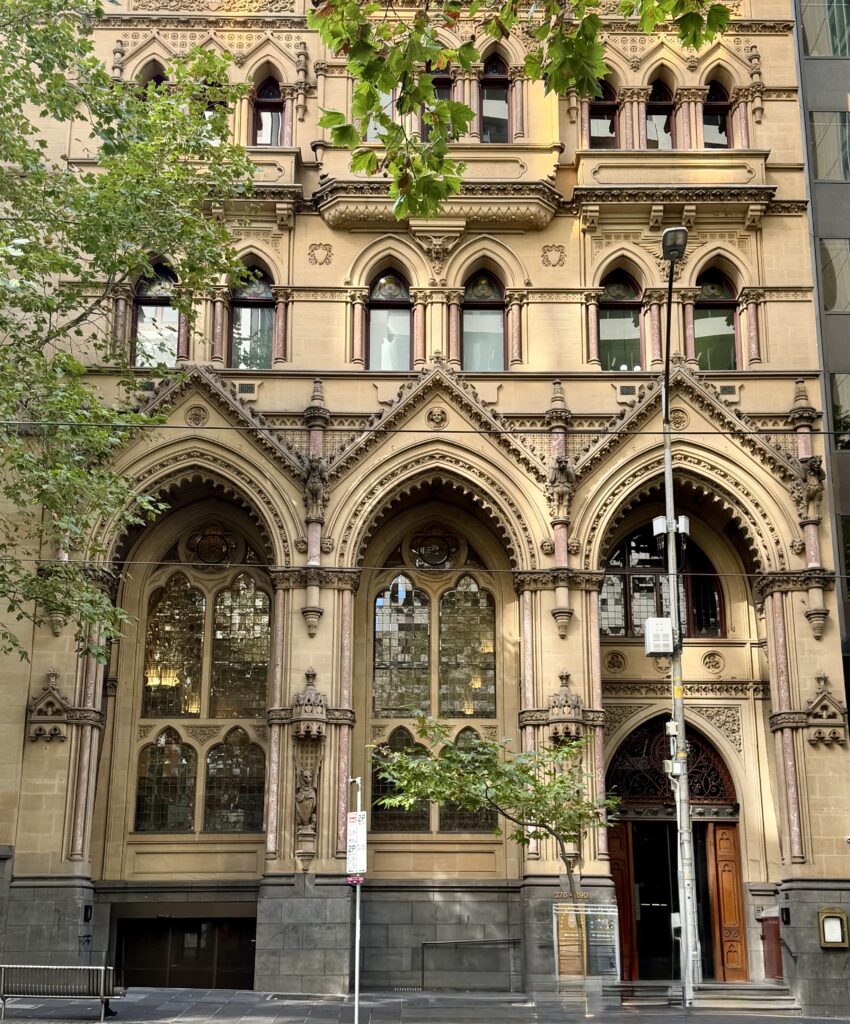
ANZ Gothic Bank – Completed in 1887, this Gothic Revival building was originally built as the head office of the English, Scottish and Australian Bank and later became part of ANZ’s headquarters. Today, it houses the ANZ Banking Museum, showcasing Australia’s banking history, and is famous for its richly decorated interior. Its exterior is adorned with carved statues, grotesques, and decorative tracery.
These elements give the building a grand, cathedral-like appearance symbolizing strength and stability.
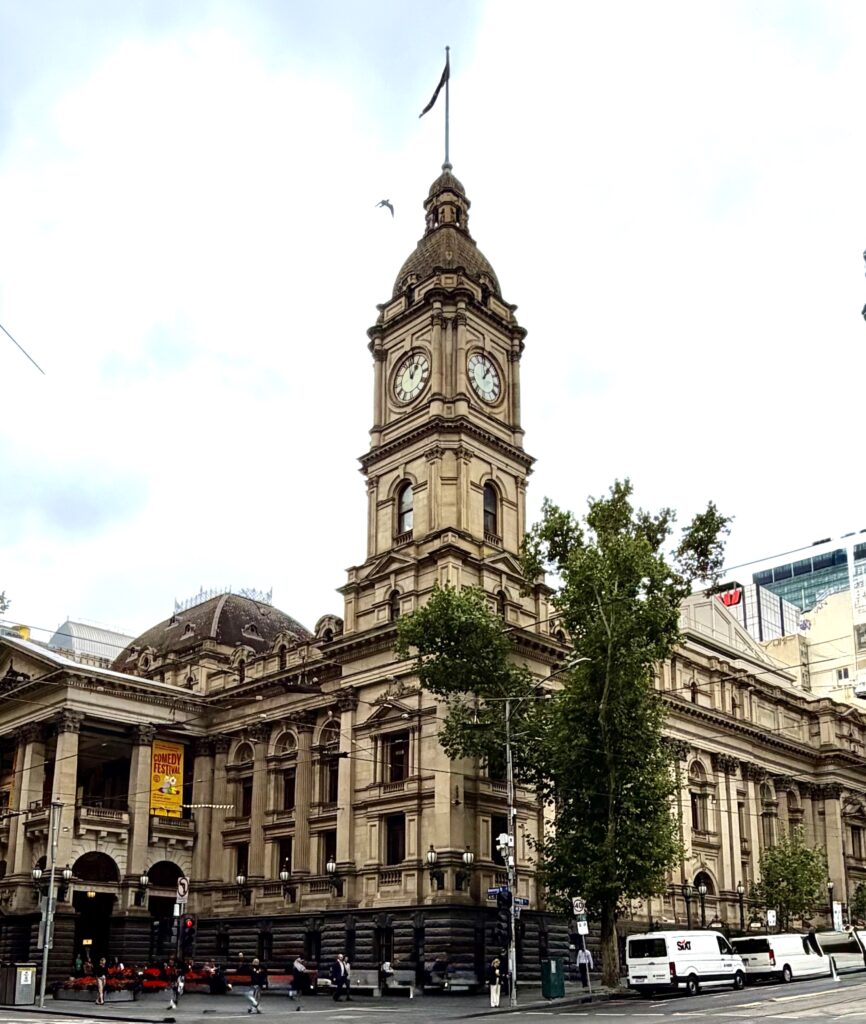
Melbourne Town Hall – features a grand Victorian-era façade in a classical style. Its exterior includes a prominent clock tower, arched windows, and ornate columns. Today, the Melbourne Town Hall is used as a major civic and cultural venue in Melbourne. It hosts official functions, council meetings, and public events, as well as concerts, exhibitions, and festivals.