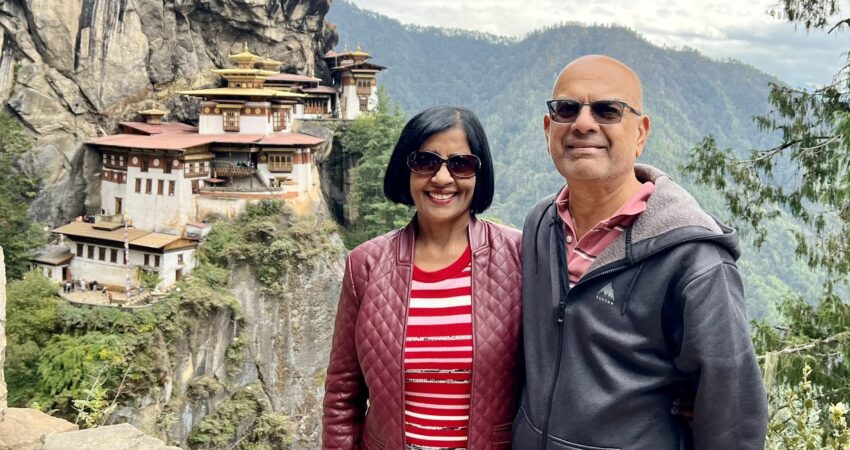
Kuzuzangpo la ! Nestled deep within the eastern Himalayas, Bhutan has quietly preserved its traditions, landscapes, and way of life — a nation that values the well-being of its citizens and the environment over economic growth. Here, traditions are not put on display for tourists; they are woven into everyday life. You won’t find towering skyscrapers — instead, you’ll see rolling green hills, tranquil villages where time moves unhurriedly, and rivers flowing freely through valleys, dotted with ancient fortresses(Dzongs), chortens, and temples(Lhakhangs).
We had booked a six-day guided tour that included both a guide and a driver, and we were very happy with the team assigned to us. Pemba, our guide, was very knowledgeable about Bhutanese culture, history, traditions, and cuisine, and he answered all our questions with ease. Thanks to him, we were able to visit all the attractions that had been planned for us.
- Paro to Thimphu – Day 1
- Thimphu – Day 2-3
- Punakha – Day 3-4
- Paro – Day 5-6
Things to know about visiting Bhutan –
- Travelling to Bhutan is expensive due to the requirement for International tourists to pay the Sustainable Development Fee (SDF). This is in addition to costs of flights, accommodation, food, and a guide. As US citizens we paid $100/person/day as SDF.
- Tourism in Bhutan is managed by licensed tour operators, and a guide is mandatory for tourists.
- Flights to Bhutan is limited to 2 airlines – Drukair and Bhutan Airlines and are often more expensive.
- Visa is required for all nationalities except Indian, Bangladesh, and Maldivian.
- You cannot take pictures inside most of the temples. You are allowed to take pictures inside forts and museums.
A few Bhutanese words that will help in your travel –
- Dzong – A fortress-monastery.
- Lhakhang – A monastery or temple.
- Chorten – A stupa
- Goenkhang – An inner chapel dedicated to protecting deities.
- Chho – River
- Dakas and Dakinis – enlightened beings in Tibetan Buddhism, associated with wisdom and compassion-based activities
- Kira – Traditional Bhutanese dress for women.
- Gho – Traditional Bhutanese dress for men.
- Vajrayana Buddhism – Majority of Bhutanese follow Vajrayana Buddhism, which is the state religion and a spiritual heritage of the country. It is a branch of Mahayana Buddhism that emphasizes a faster path to enlightenment through rituals like meditation, mantras, and mudras.
- Vajrakilaya – is a wrathful deity, representing the fierce energy needed to overcome obstacles, both external and internal. The deity is closely associated with a ritual dagger that represents a spiritual tool for cutting through obstacles.
Important people in Bhutan –
- Guru Rinpoche (or Padmasambhava) – A Buddhist master from India who brought Buddhism to Bhutan in the 8th century, establishing it as the dominant religion. You will see his statue in all the temples alongside Buddha and Ngawang Namgyal
- Ngawang Namgyal (1st Zhabdrung Rinpoche) – A Tibetan lama who unified Bhutan in the 17th century and established a dual system of government, laying the foundation for the modern nation-state. He is called the founder of Bhutan. You will see his statue in all the temples alongside Buddha and Guru Rinpoche.
- The Wangchuck Dynasty – The Wangchuck kings have ruled Bhutan since the establishment of the monarchy in 1907.
- Ugyen Wangchuck – The founder and first King of Bhutan, who unified the country and ended civil unrest, establishing the monarchy in 1907.
- June Dorji Wangchuck (3rd King) – Known for modernizing Bhutan, he oversaw the construction of infrastructure like roads and hospitals and gained crucial financial support from India.
- Jignesh Singye Wangchuck – 4th King Instituted significant modern reforms and eventually abdicated in favor of his son, Jigme Khesar Namgyel Wangchuck.
- Jigme Khesar Namgyel Wangchuck (5th King) The current monarch after his father abdicated the throne.